
Top 5 Editorial Picks
Five current picks chosen for distinct deep drop needs — from a sonar-first 7-inch unit to a premium expandable system and our top electric reel. These are editorial selections, not ratings.
As an Amazon Associate, we earn from qualifying purchases.
Best Fish Finder for Deep Drop Fishing
Disclosure: DeepDropFishing.com is reader-supported. When you buy through links on our site, we may earn a commission at no extra cost to you. We only recommend gear we would rig ourselves.
Most best fish finder lists are written for bass boats and bays. Deep drop fishing is a different problem: you are trying to read structure, bait, and fish hundreds of feet below the boat, often in 300 to 2,000+ feet of water, and a unit that looks great in 40 feet can go blind long before your rig reaches the bottom. So this guide does not rank by screen size or brand name. It ranks by the things that decide whether a sounder still works at depth – rated sonar depth, output power, frequency, and cone coverage – checked against the manufacturers own documentation, the same way we handle every product in how we choose and test gear.
We only include models we have fully reviewed on this site. That keeps this list short – two units – but every number below is a verified manufacturer spec, not a copied store listing.
Quick Answer
- Best for true deep drop fishing: Humminbird XPLORE 9 – rated to 1,200 ft on its standard sonar, and up to 3,500 ft with the optional 50 kHz accessory transducer.
- Best budget pick for mid-depth water: Garmin STRIKER Vivid 7sv – a simple, capable unit for inshore, bay, and moderate depths, but plainly not a 1,000 ft+ deep-drop sounder.
- Best setup for the deepest drops: XPLORE 9 plus the 50 kHz accessory transducer – the configuration to choose if your spots regularly sit past the standard units rated range.
Why Deep Drop Fishing Is Different for a Fish Finder
Depth eats weak sonar
A fish finder ping has to travel down to the bottom and back. In deep drop water – roughly 300 to 2,000+ feet – that is a long round trip, and the returning echo is faint. Two things decide whether the unit still paints a usable picture: how deep the sonar is actually rated to read, and how much power it pushes. Higher output power helps produce stronger deep returns, which is why a serious deep-water unit wattage is worth checking before its screen size. A bright display showing nothing is still nothing.
Frequency is a trade-off, not a feature list
Lower frequencies travel deeper; higher frequencies give finer detail but fade sooner. Shallow-water imaging sonar is built for detail near the boat. Deep work leans on lower-frequency, depth-first sonar. That is why the XPLORE 9 headline number is not its imaging – it is the 1,200 ft standard depth rating, extendable to 3,500 ft with an optional 50 kHz accessory transducer. Frequency choice is also why the transducer matters as much as the head unit; we cover that in its own guide best transducer for deep drop fishing.
Cone angle decides what you actually see
At depth, the sonar cone spreads wide before it reaches the bottom. A wide cone covers more water but smears the picture and can leave you unsure whether a mark is under the boat or off to the side. Narrower cone angles help at depth because they concentrate the ping on a smaller patch of bottom – the patch your rig is actually dropping into. When you are trying to land a bait on a ledge edge or a small wreck, that focus matters more than a long feature list.
Charts, waypoints, and staying on the spot
Deep drop spots are small and far offshore. Once you find one, you need to get back to it and hold on it. Accurate GPS waypoint storage is therefore part of a deep-drop fish finder, not an extra. Note the difference between the two units below: both store waypoints, but only one includes built-in chart mapping. For the full picture of how a fish finder fits into a deep drop setup, see our complete deep drop fishing guide.
The Two Reviewed Models, Side by Side
| Deep-water criterion | Garmin STRIKER Vivid 7sv | Humminbird XPLORE 9 |
|---|---|---|
| Role in this guide | Budget / mid-depth pick | The deep-drop pick |
| Rated sonar depth | No 1,000 ft+ deep-drop rating – a mid-depth unit | 1,200 ft standard; up to 3,500 ft with optional 50 kHz accessory transducer |
| Sonar power | 500 W (RMS) | 1,000 W RMS / 8,000 W peak-to-peak |
| Sonar types | Traditional CHIRP, ClearVu (down), SideVu (side) | Dual Spectrum CHIRP, MEGA Side Imaging+, MEGA Down Imaging+ |
| Transducer in the box | GT52HW-TM included | XM 14 HW CMSI T included (Item 412000-1) |
| Screen | 7-inch WVGA, 800 x 480 | 9-inch, 1280 x 720 |
| Controls | Buttons only – no touchscreen | Cross Touch – touchscreen plus keypad |
| GPS / charts | GPS waypoint marking; no built-in navigation charts | Built-in GPS with Humminbird Basemap; LakeMaster and CoastMaster VX mapping |
| Waypoints / routes | 5,000 waypoints, 50 routes | 10,000 waypoints, 50 routes, 50 tracks |
| Networking | Not a networked chartplotter unit | Ethernet, NMEA 2000, Bluetooth, Wi-Fi |
| Water rating / warranty | IPX7 | Three-year warranty with registration |
Read the table honestly and the story is simple: one of these units is rated for the depths deep drop anglers actually fish, and one is not. The sections below treat each one fairly – including where the cheaper unit is the right buy.
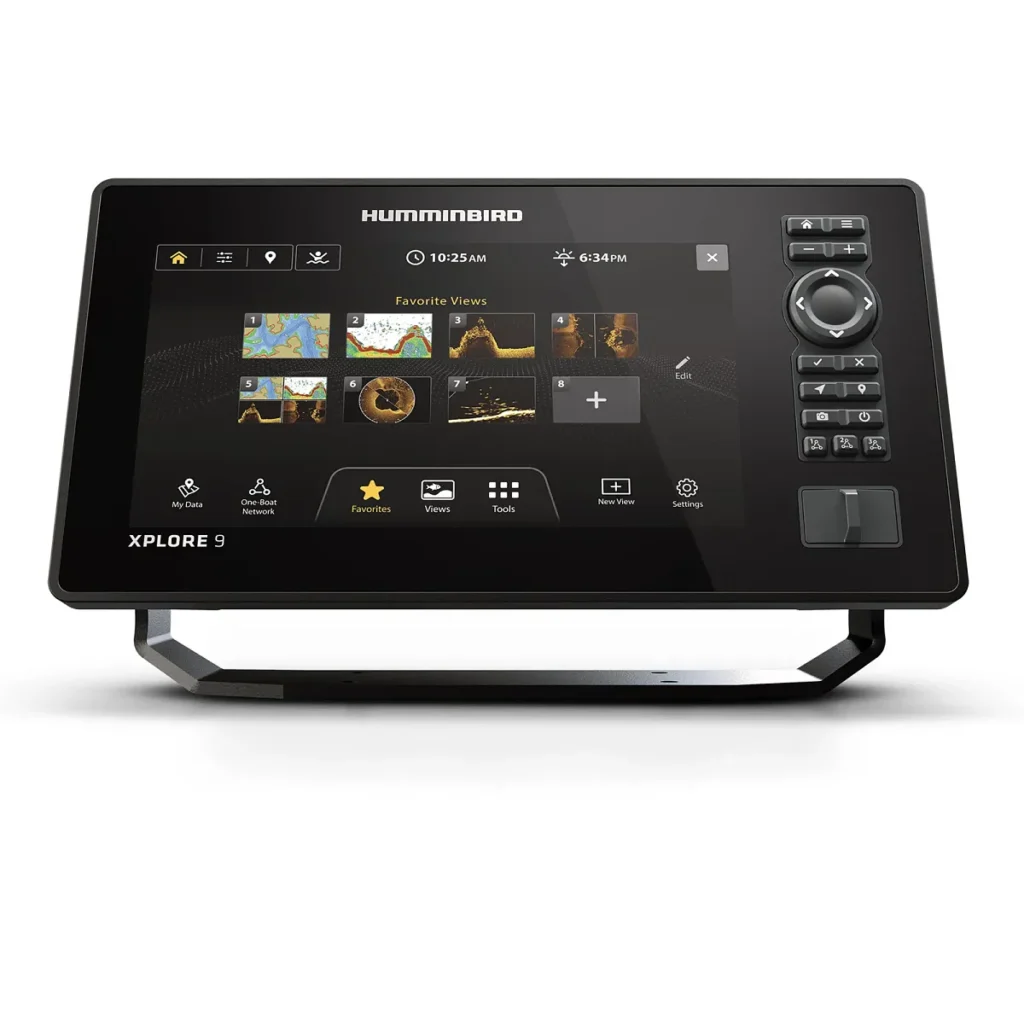
Humminbird XPLORE 9 – The Deep-Drop Pick
Strapline: The only unit in this guide actually rated for deep drop depths.
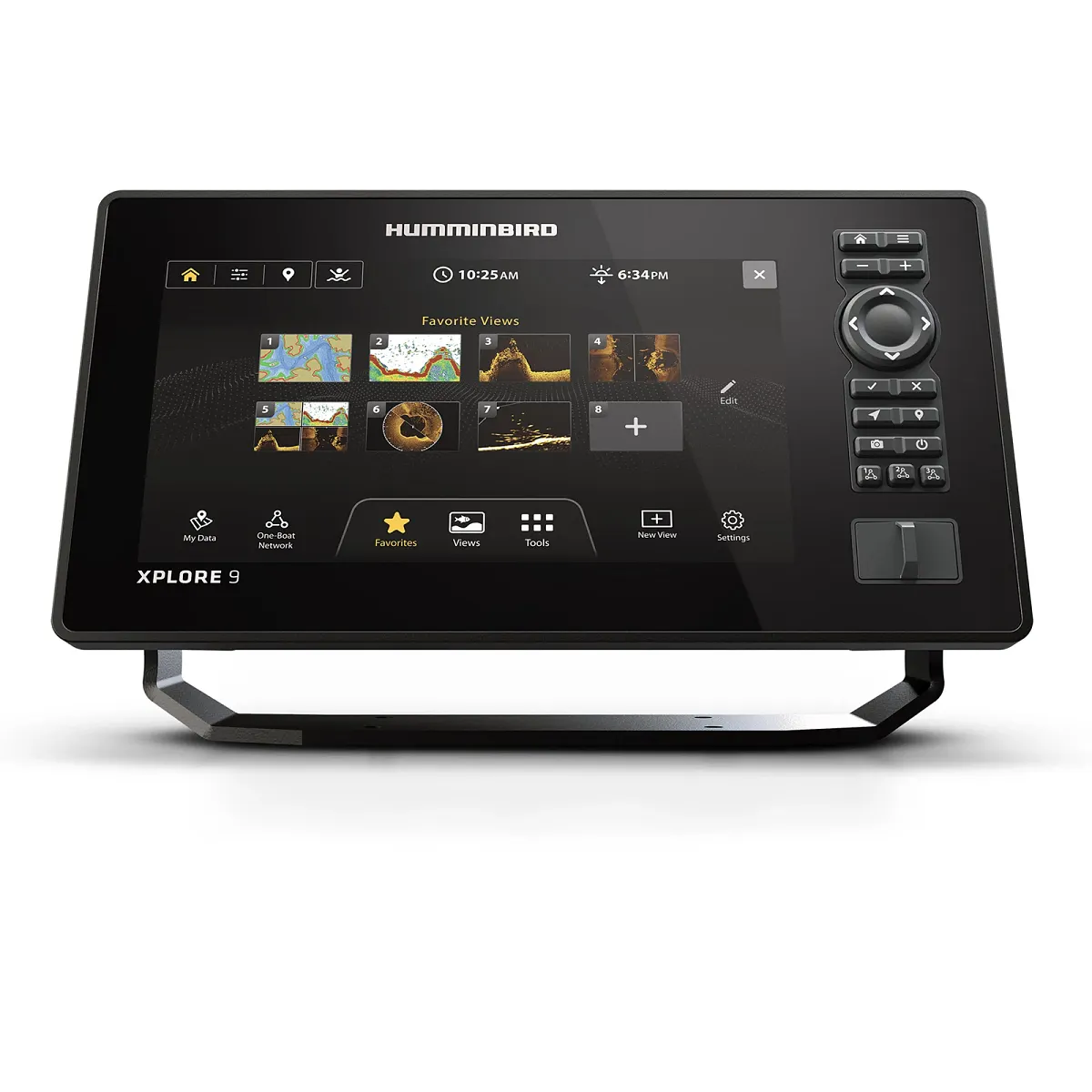
The XPLORE 9 is a 9-inch fish finder and chartplotter built around a simple headline: its Dual Spectrum CHIRP sonar is rated to 1,200 feet in standard form, and with the optional 50 kHz accessory transducer that figure extends to 3,500 feet. Those are the depths deep drop fishing happens at, and no amount of shallow-water image quality substitutes for a depth rating that reaches your spots. Output power backs the rating up – 1,000 W RMS (8,000 W peak-to-peak), double the STRIKER RMS figure – which supports stronger returns from deep water.
Around that deep core, the rest of the unit is built for offshore work. The 9-inch 1280 x 720 display uses Humminbird Cross Touch interface, meaning full touchscreen control backed by a physical keypad – useful when your hands are wet or the boat is moving. MEGA Side Imaging+ and MEGA Down Imaging+ handle the detailed picture in shallower water and on the way out, while the dual-spectrum 2D sonar does the deep work. Mapping is built in: Humminbird Basemap comes loaded, with LakeMaster and CoastMaster VX chart support, and the unit stores 10,000 waypoints, 50 routes, and 50 tracks. Ethernet, NMEA 2000, Bluetooth, and Wi-Fi cover networking with the rest of the boat electronics. The included transducer is the XM 14 HW CMSI T (Item 412000-1), and the unit carries a three-year warranty when registered.
Our full breakdown, including the complete verified spec table, is in the Humminbird XPLORE 9 review.
XPLORE 9 specifications
| Specification | Detail |
|---|---|
| Display | 9-inch, 1280 x 720, Color TFT |
| Controls | Cross Touch – touchscreen plus keypad |
| Sonar | Dual Spectrum CHIRP; MEGA Side Imaging+; MEGA Down Imaging+ |
| Sonar depth | 1,200 ft standard; up to 3,500 ft with optional 50 kHz accessory transducer |
| Transducer | XM 14 HW CMSI T (Item 412000-1) |
| Power | 1,000 W RMS; 8,000 W peak-to-peak |
| Mapping | Humminbird Basemap; LakeMaster and CoastMaster VX |
| Waypoints / routes / tracks | 10,000 / 50 / 50 |
| Networking | Ethernet, NMEA 2000, Bluetooth, Wi-Fi |
| Warranty | Three-year warranty with registration |
Buy it if:
- Your deep drop spots sit anywhere from a few hundred feet down to around 1,200 ft – or deeper with the accessory transducer.
- You want one unit that combines depth-rated sonar, built-in charts, and full networking.
- You prefer touchscreen control with a keypad backup offshore.
Skip it if:
- You only fish shallow or mid-depth water – you would be paying for depth range you never use.
- Your console cannot fit a 9-inch unit.
- Your budget is the deciding factor and your spots are modest depths (see the STRIKER below).
Check Price – Humminbird XPLORE 9
Disclosure: DeepDropFishing.com is reader-supported. When you buy through links on our site, we may earn a commission at no extra cost to you. We only recommend gear we would rig ourselves.
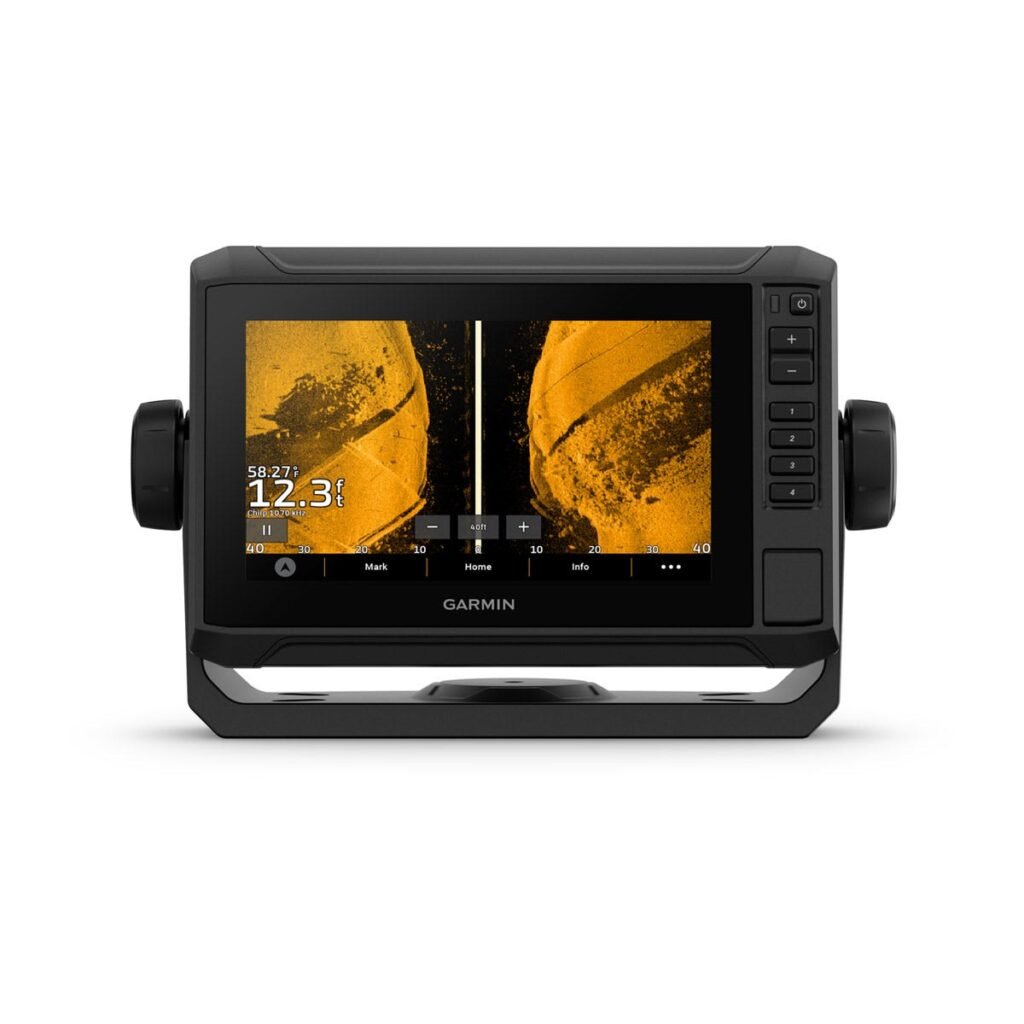
Garmin STRIKER Vivid 7sv – The Honest Mid-Depth Pick
Strapline: A good fish finder – for the water it was actually built for.
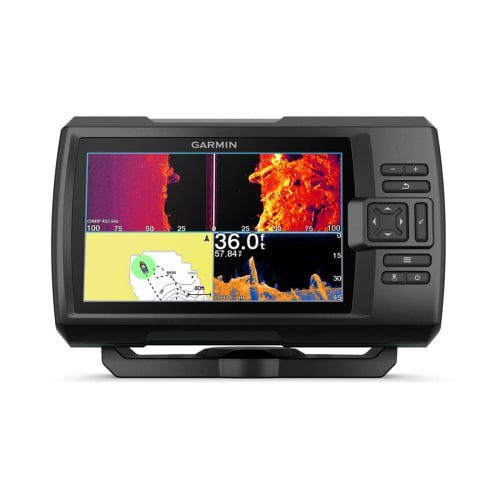
Let us be direct, because most roundups are not: the STRIKER Vivid 7sv is not the tool for true 1,000 ft+ deep drop fishing, and we will not pretend otherwise. It carries no deep-drop depth rating in that class, and its 500 W (RMS) output is half the XPLORE 9. If your spots are four figures deep, this is the wrong unit, full stop.
What it is, is a genuinely good mid-depth fish finder for a smaller boat. The 7-inch WVGA screen (800 x 480) is button-controlled – no touchscreen – which some anglers prefer with wet or gloved hands. It covers three sonar views in one unit: traditional CHIRP, ClearVu down imaging, and SideVu side imaging, through the included GT52HW-TM transducer (US model 010-02553-00). Built-in GPS marks and stores up to 5,000 waypoints and 50 routes – but be clear on the limit: it has no built-in navigation charts, so it marks spots rather than mapping them. The housing is rated IPX7. For inshore, bay, and moderate-depth bottom fishing from a small-to-mid-size boat, that is a sensible, honest package – and it is the same unit many of our readers already run for exactly that work.
Read the complete verified breakdown in our Garmin STRIKER Vivid 7sv review.
STRIKER Vivid 7sv specifications
| Specification | Detail |
|---|---|
| Display | 7-inch WVGA, 800 x 480 |
| Controls | Buttons – no touchscreen |
| Sonar | Traditional CHIRP; ClearVu; SideVu |
| Transducer | GT52HW-TM included (US model 010-02553-00) |
| Power | 500 W (RMS) |
| GPS / charts | Built-in GPS for waypoints; no built-in navigation charts |
| Waypoints / routes | 5,000 waypoints, 50 routes |
| Water rating | IPX7 |
| Deep-drop suitability | Mid-depth use – not a 1,000 ft+ deep-drop sounder |
Buy it if:
- You fish inshore, bays, or moderate depths from a small-to-mid-size boat.
- You want traditional, down, and side sonar plus waypoint marking in one affordable unit.
- You prefer physical buttons over a touchscreen.
Skip it if:
- You deep drop at 1,000 ft or beyond – it is not rated as that tool.
- You need built-in navigation charts.
- You need live-scanning sonar or a touchscreen.
Check Price – Garmin STRIKER Vivid 7sv
Disclosure: DeepDropFishing.com is reader-supported. When you buy through links on our site, we may earn a commission at no extra cost to you. We only recommend gear we would rig ourselves.
Which One Fits Your Boat and Your Depths?
| Your fishing | Our pick | Why |
|---|---|---|
| Inshore, bay, and mid-depth bottom fishing | Garmin STRIKER Vivid 7sv | Covers traditional, down, and side sonar with waypoint marking at a budget level |
| Deep drop spots in the few-hundred-feet range, growing into deeper water | Humminbird XPLORE 9 | Rated to 1,200 ft standard, with headroom instead of a hard ceiling |
| Deep drop at 1,000 ft+ as your normal fishing | Humminbird XPLORE 9 | The only reviewed unit here with a depth rating in this class |
| The deepest drops, past the standard rating | XPLORE 9 + optional 50 kHz accessory transducer | Extends rated sonar depth to 3,500 ft |
| You need built-in charts for offshore navigation | Humminbird XPLORE 9 | Basemap built in plus LakeMaster / CoastMaster VX support; the STRIKER has no built-in charts |
| Small boat, simple setup, buttons over touchscreens | Garmin STRIKER Vivid 7sv | Compact 7-inch button-controlled unit, IPX7 |
Frequently Asked Questions
What makes a fish finder good for deep drop fishing?
Three things: a sonar depth rating that actually reaches your spots, enough output power to get readable returns from that depth, and a frequency and cone setup suited to deep water – lower frequencies travel deeper, and narrower cones keep the picture focused on the water under the boat. Screen size and shallow-water imaging come after those, not before.
How deep can the Humminbird XPLORE 9 read?
Its standard sonar is rated to 1,200 feet. With the optional 50 kHz accessory transducer, the rated depth extends to 3,500 feet. Real-world readings always vary with water clarity, bottom type, boat speed, and installation quality.
Can the Garmin STRIKER Vivid 7sv be used for deep drop fishing?
Only in the shallow end of the technique. It is a capable mid-depth unit for inshore, bay, and moderate-depth fishing, but it is not a 1,000 ft+ deep-drop sounder and we do not recommend it as one. For genuine deep drop depths, choose a unit with an explicit deep depth rating, like the XPLORE 9.
Does the fish finder or the transducer matter more at depth?
Both, and they work as a pair. The head unit sets the power and processing; the transducer sets how that power reaches the water. A deep-rated unit still depends on the right transducer, which is why we treat transducer choice as its own decision best transducer for deep drop fishing.
Do I need built-in charts on a deep drop fish finder?
If you run offshore to small, specific spots, charts plus generous waypoint storage make returning to those spots far easier. The XPLORE 9 includes built-in basemap charts and stores 10,000 waypoints. The STRIKER Vivid 7sv stores 5,000 waypoints but has no built-in navigation charts, so it marks positions without mapping them.
Final Verdict
For deep drop fishing, this guide has one real answer and one honest alternative. The Humminbird XPLORE 9 is the pick: a 1,200 ft standard depth rating that extends to 3,500 ft with the accessory transducer, 1,000 W RMS of power, built-in charts, and full networking – the complete package for anglers whose spots live in deep water. The Garmin STRIKER Vivid 7sv earns its place only when the fishing is shallower: a simple, capable mid-depth unit that we recommend for what it is, and refuse to oversell for what it is not. Match the unit rated depth to the water you actually fish, and the choice makes itself.
More fish finder reviews: Simrad GO9 XSE Review · Lowrance Eagle 5 Review · Humminbird HELIX 9 Review · Furuno FCV-588 Review