
Top 5 Editorial Picks
Five current picks chosen for distinct deep drop needs — from a sonar-first 7-inch unit to a premium expandable system and our top electric reel. These are editorial selections, not ratings.
As an Amazon Associate, we earn from qualifying purchases.
Lowrance HDS PRO 10 Review
Disclosure: DeepDropFishing.com is reader-supported. When you buy through links on this page, we may earn a small commission at no extra cost to you. This review is based on Lowrance’s published specifications and documentation — not on paid placement.
Quick Answer
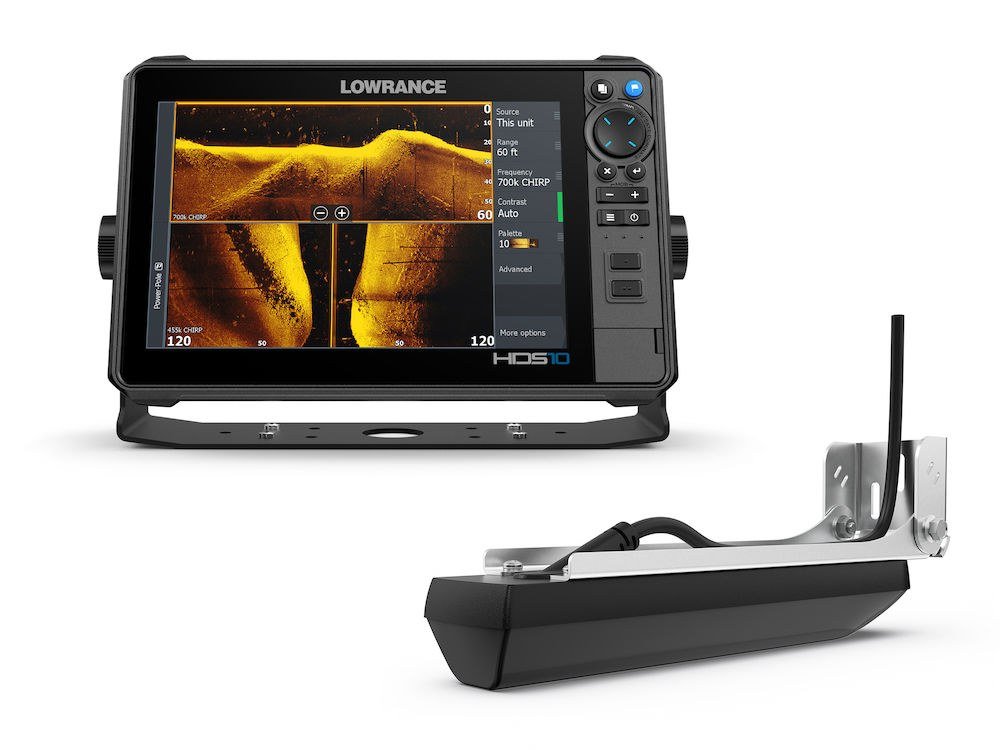
The Lowrance HDS PRO 10 is the 10-inch model in Lowrance’s professional-tier HDS Pro series: a SolarMAX HD multitouch display (1280 x 800, over 1,200 nits), dual-channel CHIRP sonar rated up to 1 kW, Active Imaging HD scanning sonar up to 1.2 MHz, and two independent sonar ports so a deep-water transducer and the imaging transducer can stay plugged in at the same time. It ships with the Active Imaging HD 3-in-1 transducer and preloaded C-MAP DISCOVER OnBoard charts, or as a no-transducer unit for custom setups. For deep-drop and offshore anglers, the headline is the architecture: a display designed to run serious transducers and anchor a full networked system.
Who This Unit Is For
The HDS PRO 10 is not an entry-level fishfinder. Lowrance positions the HDS Pro line as its professional tier, and the 10-inch model is the size most offshore anglers will land on: big enough for split-screen chart, sonar and imaging work, small enough for a crowded console.
For deep-drop readers, the appeal is specific. Deep water punishes weak sonar: you need power, low frequencies and a transducer chosen for depth, not the all-in-one puck bundled with shallow-water combos. The HDS PRO 10 answers with up to 1 kW of CHIRP output, two sonar ports, and compatibility with Lowrance’s S3100 and S5100 sonar modules. If you fish wrecks, ledges and deep bottom — or plan to — it is built on the right side of the line.
Key Specs
| Spec | Lowrance HDS PRO 10 |
|---|---|
| Display | 10″ SolarMAX HD multitouch touchscreen |
| Resolution | 1280 x 800 pixels |
| Brightness | >1,200 nits; 80° viewing angles |
| Sonar built in | Dual-channel CHIRP Broadband; Active Imaging HD DownScan and SideScan |
| CHIRP power | Low, Medium and High CHIRP, up to 1 kW |
| Imaging frequencies | DownScan 455/800 kHz, CHIRP 700/1200 kHz; SideScan 455/800 kHz, CHIRP 455/1075 kHz |
| Sonar ports | 2 x 9-pin (Sonar 1 + Sonar 2/Imaging) |
| Live sonar | ActiveTarget 2 / ActiveTarget 2 XL ready (sold separately) |
| Transducer options | With Active Imaging HD 3-in-1, or no transducer |
| Preloaded charts | C-MAP DISCOVER OnBoard (U.S. versions) |
| Networking | 2 x Ethernet, NMEA 2000, Wi-Fi, Bluetooth 5.2 |
| Card slots | 2 x microSD |
| Power | 12 V DC (10.8–18 V); max 40 W (2.9 A); 3 A fuse |
| Dimensions | 294.6 x 193.2 x 82.6 mm (11.6 x 7.6 x 3.3 in.) |
| Weight (display only) | 1.66 kg (3.66 lb) |
| Water rating | IPX6 and IPX7 |
Display and Charts
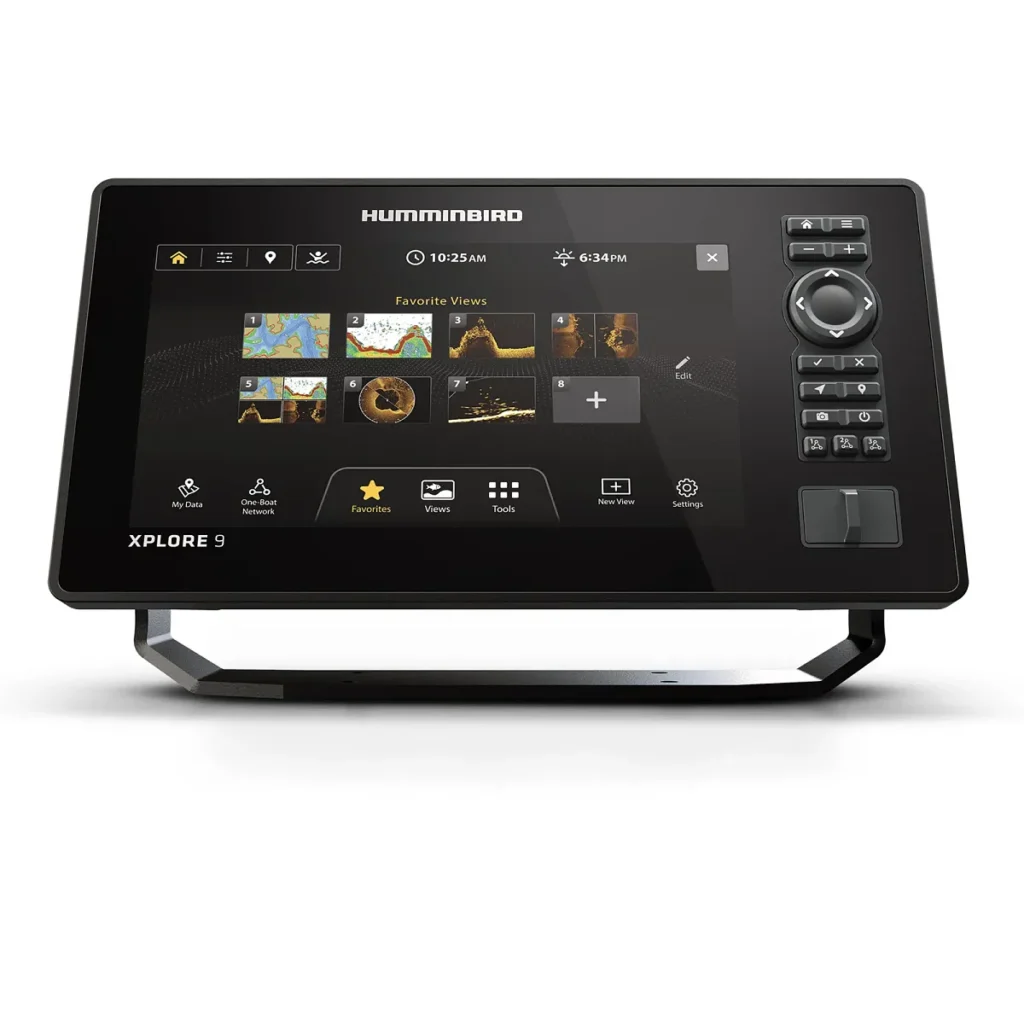
The SolarMAX HD screen is the first thing Lowrance talks about, and the specs back the emphasis: 1280 x 800 resolution, brightness above 1,200 nits, and 80-degree viewing angles in every direction. Lowrance states the display stays easy to read at extreme angles, in direct sunlight and through polarized lenses — the three conditions that wash out lesser screens on an open boat. It is a full multitouch panel, and the 10-inch size gives split views (chart plus sonar, sonar plus SideScan) room to breathe in a way 7-inch units cannot. Compare the approach in our Humminbird XPLORE 9 review: both are premium offshore displays, but the Lowrance leans harder into networking and transducer flexibility.
U.S. versions come preloaded with C-MAP DISCOVER OnBoard charts, including 1-foot contours on more than 19,000 U.S. lakes and over 9,400 Canadian lakes. Genesis Live lets you build custom half-foot contour maps of uncharted water in real time — genuinely useful on deep-drop marks that charts draw as blank blue. The unit also accepts C-MAP REVEAL charts, Navionics cards and other third-party options through its two microSD slots, and can overlay ActiveTarget 2 XL Scout Mode or Ghost 360 views on the chart screen.
Sonar and Transducer
The sonar story has three layers. First, built-in dual-channel CHIRP broadband sonar covers Low, Medium and High CHIRP at up to 1 kW — the power class you want behind a deep-water transducer. Second, Active Imaging HD delivers DownScan and SideScan imaging up to 1.2 MHz, with FishReveal combining CHIRP targets onto the DownScan image so fish stand out from structure. Third, the unit is ready for ActiveTarget 2 and ActiveTarget 2 XL live sonar when you add those transducers, including the Scout Live 360 view that combines two live systems.
The hardware detail that matters most for our kind of fishing is at the back panel: two separate 9-pin sonar ports. The version sold with a transducer bundles the Active Imaging HD 3-in-1, a transom-mount unit that produces CHIRP, SideScan and DownScan together. On most combo units, adding a second transducer means unplugging the first or buying a module. On the HDS PRO 10, the imaging transducer takes one port and a dedicated deep-water CHIRP transducer can live on the other — both connected, both selectable on screen. Lowrance’s installation manual confirms both ports support Low/Medium/High CHIRP up to 1 kW, with the imaging port additionally carrying SideScan frequencies. If you are choosing that second transducer, our best transducer guide for deep drop fishing walks through frequency and beam choices; the HDS PRO 10 also appears in our roundup of the best fish finders for deep drop fishing.
Networking is equally complete: two Ethernet ports for radar, sonar modules and additional displays with waypoint, chart and sonar sharing; NMEA 2000 for engines and sensors; built-in Wi-Fi and Bluetooth 5.2; and touchscreen control of Ghost and RECON trolling motors and Power-Pole anchors, plus autopilot and SiriusXM weather/audio support.
Deep-Water Use
An honest note first: Lowrance does not publish a single headline maximum-depth number for the HDS PRO 10, on either its product page or in its installation manual. Depth is a property of the whole system — transducer element, frequency, power and water conditions — and Lowrance leaves the figure to the transducer.
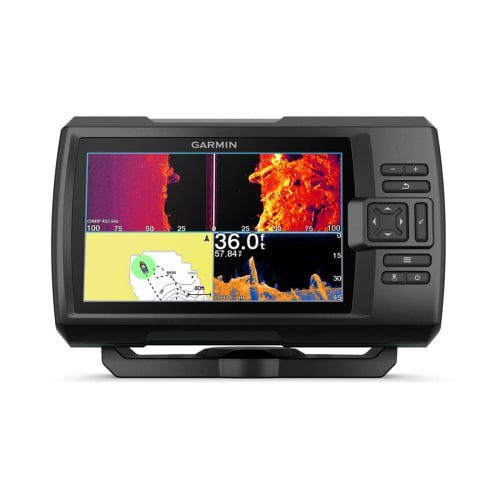
What the manufacturer does state is the capability that makes deep water possible: dual-channel CHIRP sonar at up to 1 kW, through two independent ports, with Low CHIRP available for the long wavelengths that hold together in deep water. That is the correct shopping list for deep dropping in several hundred to over a thousand feet: pair the display with a 1 kW-class low-frequency transducer on one port for bottom tracking at depth, keep the Active Imaging HD 3-in-1 on the other for finding structure, bait and wrecks on the way out, and switch views rather than cables. Anglers stepping up from a simpler unit like the one in our Garmin STRIKER Vivid 7sv review will feel the difference most here — not in a spec-sheet depth claim, but in how the system is meant to be rigged.
What’s in the Box
Per Lowrance’s installation guide, the box contains:
- HDS PRO 10 display unit
- Gimbal bracket kit (metal on the 10-inch model)
- Sun cover
- Power cable kit
- Documentation pack
Versions sold with a transducer add the Active Imaging HD 3-in-1 transducer. The no-transducer version is the right buy if you already own a compatible transducer or are going straight to a 1 kW setup. Mounting is panel (flush) or the included bracket.
Who Should Buy / Who Should Skip
Buy the HDS PRO 10 if:
- You fish deep or offshore and want up to 1 kW CHIRP power with room for a dedicated deep-water transducer alongside imaging.
- You run — or plan to run — a networked system: multiple displays, radar, autopilot, a sonar module or ActiveTarget 2 live sonar.
- You want a bright, polarized-friendly 10-inch screen with premium charts included (C-MAP DISCOVER OnBoard on U.S. versions).
- You control a Ghost or RECON trolling motor or Power-Pole anchors and want that control on the main display.
Skip it if:
- You fish small, shallow water — the HDS Pro’s power and networking will mostly go unused.
- You want one box that does everything with no decisions: the transducer choice and module ecosystem reward owners who like to configure.
- A 10-inch screen does not fit your console — the series also comes in 9, 12 and 16 inches, so change size rather than forcing the fit.
FAQ
Does the Lowrance HDS PRO 10 come with a transducer?
You choose. One version bundles the Active Imaging HD 3-in-1 transducer, which provides CHIRP sonar plus SideScan and DownScan imaging from a single transom-mount unit. The other version is the display only, with no transducer, for owners who already have one or want to select their own.
What sonar power does the HDS PRO 10 have?
Lowrance’s installation manual rates both sonar ports for Low, Medium and High CHIRP up to 1 kW. Imaging runs at higher frequencies: DownScan CHIRP at 700 and 1200 kHz, and SideScan CHIRP up to 1075 kHz (Active Imaging HD, up to 1.2 MHz).
Can I run a deep-water transducer and the imaging transducer at the same time?
Yes — that is a core design point. The HDS PRO 10 has two independent 9-pin sonar ports. The Active Imaging HD 3-in-1 connects to the imaging port, and a second CHIRP transducer (for example a 1 kW deep-water model) connects to the other, so both stay wired and selectable without swapping cables.
What charts are included with the HDS PRO 10?
U.S. versions include preloaded C-MAP DISCOVER OnBoard charts with 1-foot contours on more than 19,000 U.S. lakes and over 9,400 Canadian lakes. The unit also supports C-MAP REVEAL, Navionics and other third-party charts, and Genesis Live lets you record your own half-foot contour maps in real time.
What is the maximum depth of the HDS PRO 10?
Lowrance does not publish a maximum-depth figure for this display. Depth performance depends on the transducer, frequency and power you pair with it; the unit supports up to 1 kW CHIRP sonar through two ports, which is the manufacturer-stated capability intended for deep-water transducer setups.
The Bottom Line
The Lowrance HDS PRO 10 earns its “Pro” label in the wiring as much as on the screen: a bright 10-inch display, dual 1 kW-capable sonar ports, Active Imaging HD, and networking deep enough to run a whole boat. For deep-drop and offshore anglers building a system rather than buying a gadget, it is one of the most complete platforms in its class.