Deep Drop Fishing

Clear guides on deep drop fishing — information only, no charters

Deep Drop Fishing Gear: The Complete Beginner Setup

I’ve lost more rigs to the bottom at 900 feet than most guys have casts in a lifetime. After 20+ years dropping from 400 to 1,200 feet off South Florida, the Keys, and now the Andaman trench for golden tilefish, queen snapper, snowy grouper, yellowedge grouper, blackbelly rosefish and daytime swordfish, I can tell you this straight: deep drop fishing is not regular bottom fishing with more line.

Standard offshore bottom fishing gear will fold under the sustained load. A 3-pound sinker hanging straight down for 20 minutes puts more stress on a rod, reel and knot than a 50-pound tuna ever will. This guide is the exact deep drop equipment list I hand to first-timers on my boat. Five essentials to get you to the bottom, then the extras that save your back and your wallet.
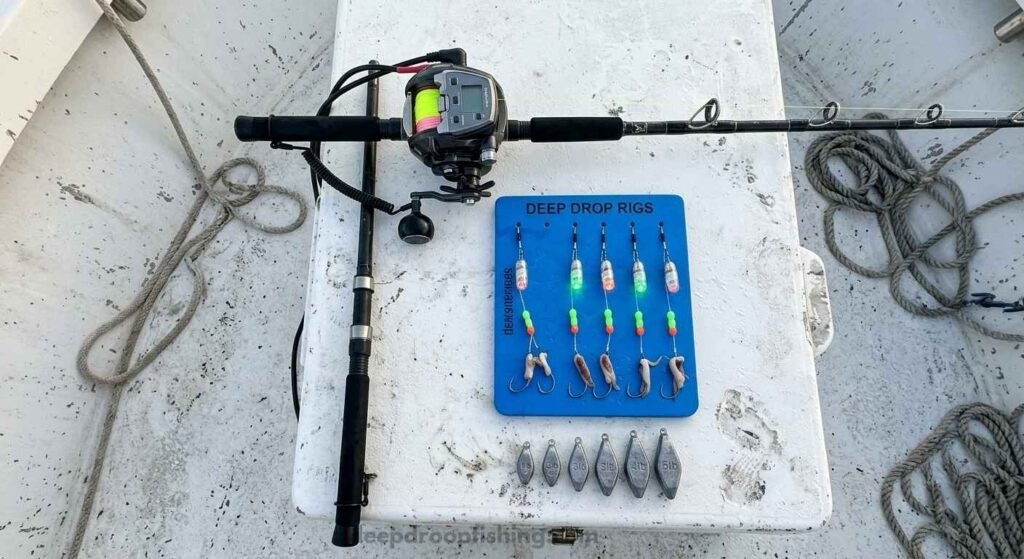
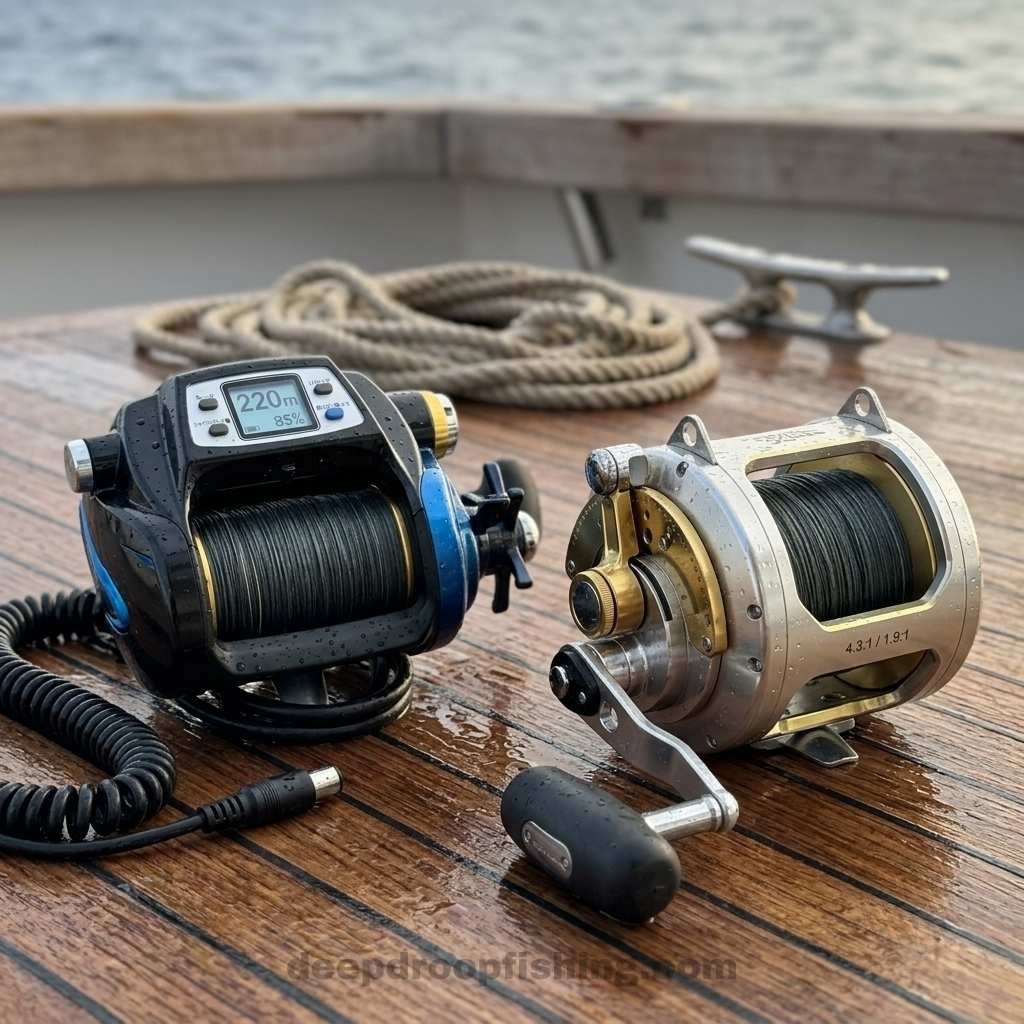
deep drop fishing gear complete beginner setup on boat deck with electric reel and weights
My deck before a tilefish trip: bent-butt rod, electric reel, metered braid, lighted chicken rigs and a full 1-5LB weight spread. Everything you need.
The 5 Essentials at a Glance

Before anything else, deep drop fishing requires offshore bottom fishing gear built for depth and constant load. Standard bottom tackle is not rated for 500+ feet of line and heavy sinkers. The five essentials are: rod, reel, line, terminal tackle (rig and hooks), and weight.

FeatureElectric ReelTwo-Speed Conventional
Best Depth600–1,200 ft300–600 ft
FatigueLowVery High
Line CounterBuilt-inAdd-on clip-on
Cost Entry$700–$1,200$250–$500
Power Needed12V Battery BoxNone

1. Rod: Why Bent Butt and Roller Guides Matter

bent butt deep drop rod with roller guides 50-80lb class

What to look for in a deep drop rod and reel combo starts with the rod. You are not casting. You are dropping straight down and holding.

Length: 5’6″ to 6’6″. Shorter gives you more leverage. Longer makes it harder to clear the outboard.

Bent butt vs straight butt: For beginners, bent butt wins. It seats in a rod holder and points the tip away from the hull, so your braid does not saw on the boat in current. A straight butt needs a fighting belt and harness to be comfortable past 600 feet. I’ve had straight butts snap at the foregrip under 4LBs of sustained load. A quality bent butt will not.

Guides: Roller guides or heavy-duty Silicon Carbide ring guides rated for braid. Cheap guides groove with 80LB braid at depth and then fray your mainline.

Rating: 50-80LB class for golden tilefish, queen snapper, rosefish, and grouper to 600-900 feet. Go 80-130LB class if you plan to daytime swordfish. Look for a rod that says “deep drop” not just “heavy bottom.”


2. Reel: Electric Reel vs Hand Crank for Deep Drop

This is where your budget decision lives. Both work, but they are different fisheries after 600 feet.

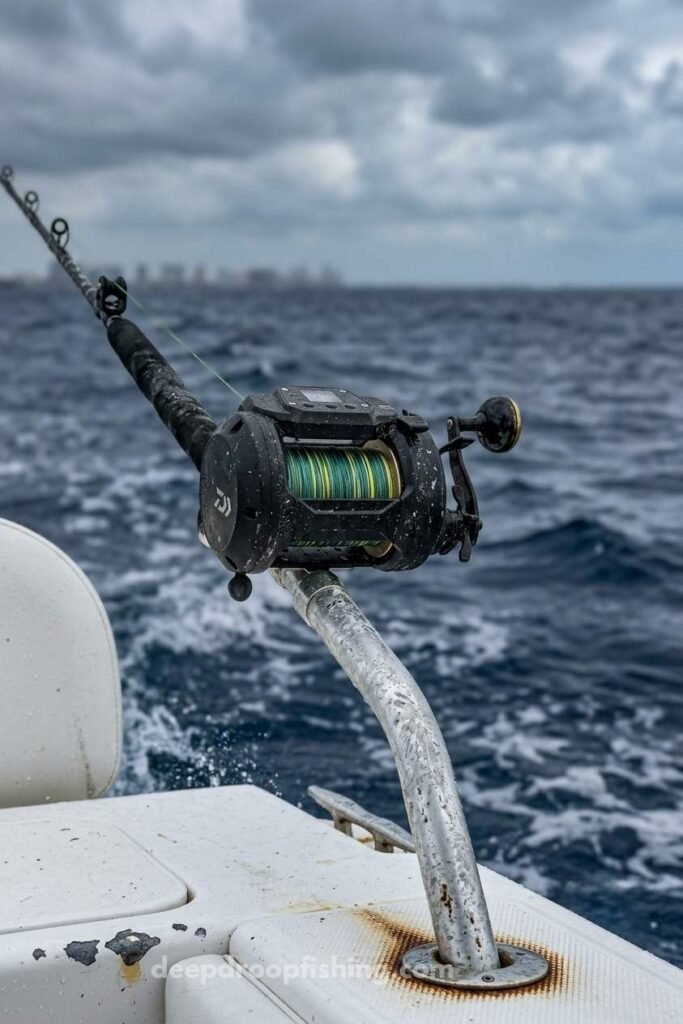
Electric reel: Retrieves line automatically. This matters most on deeper drops (800+ feet) where hand-cranking becomes exhausting after 5-6 drops. Must-haves: digital line counter in feet or meters, 600+ yards of 80LB capacity, 40LB+ max drag, 12V power cord with alligator clips, auto-stop. Run it off a dedicated 12V deep-cycle battery box – never off your starting battery. If that battery dies at 800 feet, you are hand-lining 800 feet of braid.

Conventional (hand crank) reel: Lower cost, works fine at moderate depths to 500-600 feet, but demands stamina. If you go this route, get a two-speed 4.3:1 / 1.9:1 with a big handle. High speed to take up slack, low speed to winch the last 200 feet with fish and lead.

Feature Electric Reel Two-Speed Conventional
Best Depth 600–1,200 ft 300–600 ft
Fatigue Low Very High
Line Counter Built-in Add-on clip-on
Cost Entry $700–$1,200 $250–$500
Power Needed 12V Battery Box None

3. Line: Metered Braid and Wind-On Leaders

4. Terminal Tackle: Rigs, Hooks and Lights

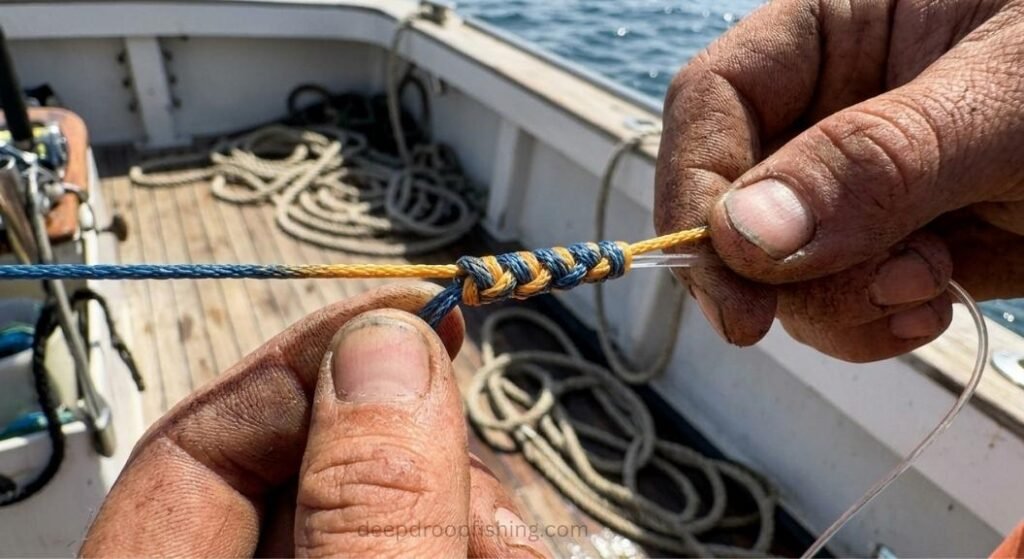
metered braided line with FG knot to wind-on leader for deep drop
Metered braid every 100ft + FG to 200LB wind-on. This knot is your whole day.


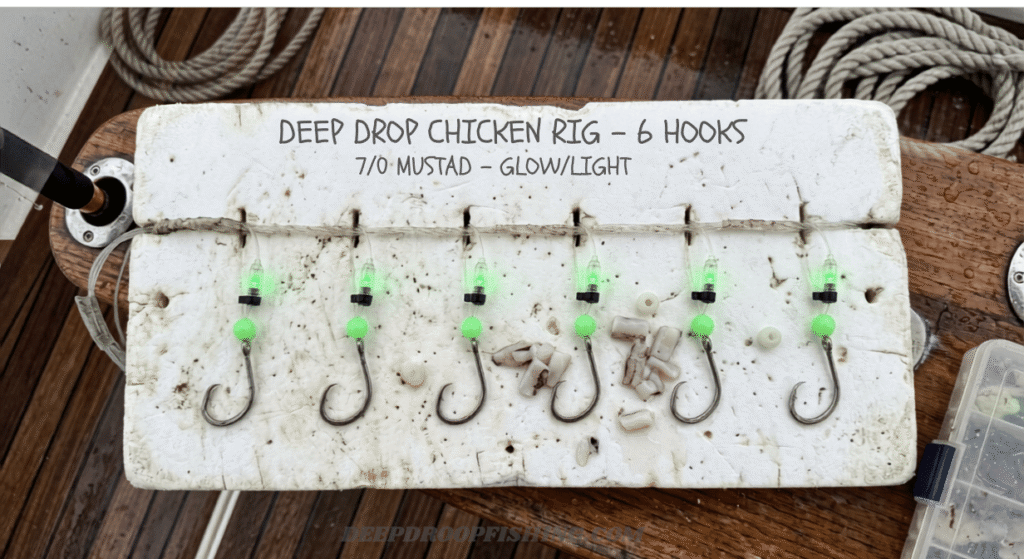
At minimum, bring 5-6 pre-tied rigs, not 3. Tangles and cutoffs happen on every trip.

Chicken rig: 5-6 dropper loops with circle hooks – the workhorse for tilefish and rosefish. Each dropper is 12-18 inches off the main leader.

Stiff rig / 3-hook rig: Shorter, stiffer leader with 3 hooks – better for larger grouper and queen snapper where you want less tangle.

Hooks: Circle hooks 7/0 to 9/0, heavy wire like Mustad 39960D. Circle hooks are often required by regulation and they self-set at depth. Don’t use J-hooks.

Lights and attractants: Below 500 feet there is no light. Tiny deep drop LED lights (green or blue) and glow beads double your bites. Clip a light every 2nd hook on a chicken rig. I have had days where no light = no bite, light = limit.

Storage: Rig board or foam holder. Do not throw rigs in a bag. You will spend 30 minutes untangling and miss the bite window.
 

5. Weight: How to Hold Bottom in Current

chicken rig with circle hooks and deep drop fishing lights
6-hook chicken rig with glow beads and clip-on lights. Pre-tie these at home.


Bring a range of sinker weights, not just one size. Current changes throughout the day, and the wrong weight means your rig drifts instead of holding bottom.

Typical range: 1LB to 5LB. My rule: 1LB per 200 feet of depth, plus 1LB extra if current is over 1.5 knots. So 800 feet in moderate current = 4LB + 1LB extra = 5LB.

Types: Bank sinkers or stick weights snag less than round cannonballs on rocky bottom. Stick weights with a fin hold better in current.

Breakaway system: Tie your weight with lighter line (30-50LB) so if you snag hard bottom, you lose the weight, not 800 feet of $80 braid and the whole rig. This saves $100 a trip when learning.


6. Nice-to-Have Extras for Offshore Bottom Fishing Gear

These aren’t required for your first trip but make repeat trips easier:

  • Fighting harness and belt: Transfers load to your hips, not your lower back
  • Heavy gloves: Braid under load will slice to bone
  • Descending device: For releasing fish safely from depth – required in many areas for grouper with barotrauma
  • Gaff or large net sized for the species you’re targeting
  • Cooler or fish bag with slurry ice – tilefish flesh is delicate
  • Pliers, dehooker, extra crimps and chafe gear

7. Beginner Gear List by Priority + Real Cost

 If you’re building your kit gradually, buy in this order:

  1. Rod and reel (the biggest investment – get this right first)
  2. Braided mainline and wind-on leader material
  3. Pre-tied rigs, lights, and spare hooks
  4. A range of sinker weights 1-5LB
  5. Rig storage board and a descending device + harness

How much does a basic deep drop setup cost?

  • Budget hand-crank deep drop rod and reel combo: $500-$800
  • Entry electric deep drop rod and reel combo: $900-$1,600
  • Line + leaders + 6 rigs + lights + weights: $200-$350
  • Reel is typically 60% of the whole setup. Buy once, cry once.
 

FAQ: Deep Drop Fishing Gear

  1. Do I need an electric reel to start deep drop fishing?
     No for under 600 feet. A hand-crank conventional reel with enough line capacity works fine for beginners, especially at moderate depths. An electric reel becomes essential past 800 feet or if you do 8+ drops a day. Your forearms will make the decision for you.
  2. Can I use my regular bottom fishing rod for deep drop fishing?
    Not reliably below 400 feet. Deep drop fishing puts more sustained load on a rod than typical bottom fishing, and most standard 20-40LB rods aren’t built to handle 3-5LBs of lead plus current for 20 minutes at a time.
  3. What depth is considered deep drop?
    Generally 400 to 1,200 feet. Golden tilefish 600-900ft, queen snapper 400-700ft, snowy and yellowedge grouper 600-1,000ft, daytime swordfish 1,200-1,800ft.
  4. What is the best line for deep drop?
    80-100LB solid metered braided line with color change every 100 feet, plus a 150-200LB wind-on fluorocarbon leader connected with an FG knot.
Scroll to Top