Fish Finder Frequencies Explained: 50/200 kHz vs CHIRP in Deep Water
Disclosure: DeepDropFishing.com is reader-supported. When you buy through links on our site, we may earn a commission at no extra cost to you. We only recommend gear we would rig ourselves.
What “Frequency” Means on a Fish Finder
Frequency is how fast the sound waves your transducer sends into the water vibrate — the number of wave cycles per second. It is measured in kilohertz (kHz), meaning thousands of cycles per second. A 50 kHz signal vibrates 50,000 times per second; a 200 kHz signal vibrates 200,000 times per second.
That one number controls the two things every angler cares about: how deep the sonar can reach, and how much detail it can show. Low frequencies use long, slow waves that lose energy slowly as they travel, so they keep going — down to deep bottom and back again. High frequencies use short, fast waves that draw a much finer picture, but the water absorbs their energy quickly, so their useful range is short.
If you only remember one line, make it this: depth comes from low frequency; detail comes from high frequency; no single frequency does both. Choosing frequencies for a fish finder is really choosing where you sit on that line — and for deep drop fishing, where baits fish at 600–2,000 feet, the answer is very different from the answer for a bay boat.
Low Frequency vs High Frequency: The Depth–Detail Trade-Off
Think of the classic pairing first, because most traditional sonar is built around it: 50 kHz and 200 kHz.
200 kHz is the detail band. Its short waves bounce back fine information — the difference between a fish, a bait ball, and the edge of a wreck shows clearly. In shallow and mid-depth water, it is the frequency you actually fish with. Its limit is physics: the energy fades fast, so a 200 kHz signal spends itself long before it can cross the deep-drop range.
50 kHz is the depth band. Its long waves survive the long trip down and back. The cost is resolution: the picture is coarser, marks are larger and less distinct, and small targets close to the bottom can blur together. What 50 kHz gives you is the one thing deep drop fishing cannot do without — a bottom reading, held reliably, at depths where higher frequencies have already gone silent.
That is why dual-frequency 50/200 kHz sonar became the classic offshore setup: run the low band to find and hold bottom in deep water, run the high band for detail when you move inshore. The two frequencies are not rivals. They are two different tools that happen to live in the same transducer.
The same trade-off continues above 200 kHz. The imaging frequencies used by down- and side-imaging systems — 455 kHz, 800 kHz and the like — produce the sharpest pictures of all, and the shortest ranges. On the Humminbird XPLORE 9, Down Imaging reaches 200 feet at its highest (MEGA) imaging frequencies and 400 feet at 455 kHz, while its ordinary sonar reaches far deeper. Imaging is a shallow-to-mid-depth detail tool. In deep water it is silent.
CHIRP Explained: One Ping, Many Frequencies
Traditional sonar pings at a single frequency: every pulse is one note. CHIRP works differently. Instead of one fixed note, a CHIRP pulse sweeps across a band of frequencies — rising through a range of kHz during each transmission.
That sweep does two useful things. First, it puts more total energy into the water over the course of each pulse, which helps the echo survive the trip. Second, because the system knows which frequency it sent at each instant, it can untangle the returning echoes more precisely. The practical result is target separation: fish holding tight against bottom structure read as separate marks instead of melting into one blob with the wreck or ledge below them. At deep-drop depths, where the decision to drop a rig rides on whether that mark is fish or structure, that separation is the whole game.
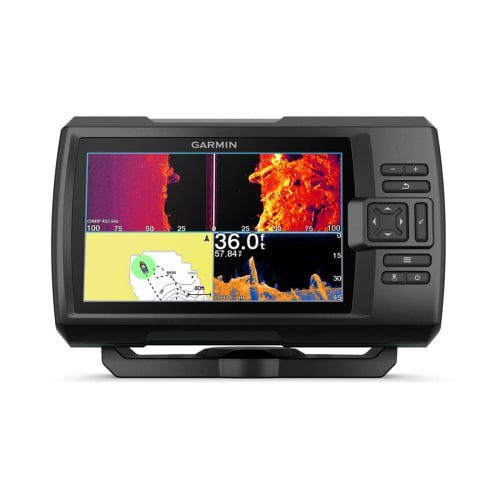
Humminbird’s Dual Spectrum CHIRP on the XPLORE 9 shows what the bands look like in practice: its CHIRP modes sweep 150–220 kHz in Full mode, 180–240 kHz in Narrow mode, and 140–200 kHz in Wide mode — a low-to-mid band chosen for a balance of depth and detail. Garmin’s traditional-sonar CHIRP on the STRIKER Vivid 7sv covers set frequencies of 50/77/200 kHz. The important thing to notice is that CHIRP describes how a signal is sent, not how deep it goes. A CHIRP sweep across a high band is still a high band: it will separate targets beautifully in the water it can reach, and it still cannot reach deep-drop bottom. The band comes first; CHIRP is an improvement within the band.
Frequency vs Depth: The Reference Table
This table describes classes of setups, not individual products — the same classes used in our transducer guide for deep drop fishing.
| Setup | Frequency behaviour | Practical depth character | Best use |
|---|---|---|---|
| 200 kHz traditional | High single frequency, fine detail | Shallow to mid-depth; energy fades well before deep-drop bottom | Bays, reefs, and structure inside a few hundred feet |
| 50 kHz traditional | Low single frequency, coarse detail | The deep-reaching end of classic sonar; built for depth over detail | Deep bottom fishing where simply holding bottom is the job |
| 50/200 kHz dual frequency | Low band for depth, high band for detail | Run the deep band offshore, the detail band inshore | Boats that fish both shallow and deep on the same unit |
| High-wide CHIRP (bundled imaging transducers) | Sweeps a high band with a wide cone | Excellent coverage and imaging in shallow-to-mid depths; not a 1,000 ft tool | General fishing, down/side imaging, marking spots in moderate water |
| Low-frequency CHIRP, 1 kW class | Sweeps a low band with high transmit power | The standard recipe for reading bottom at 1,000 ft+ | Deep drop fishing, deep bottom fishing, offshore wreck work |
| Low-frequency CHIRP, 2–3 kW class | Same low-band logic with two to three times the power | Maximum depth headroom and the strongest deep returns | Serious deep programs, very deep water, larger offshore boats |
Two patterns stand out. Every row that reaches deep-drop water is built around the low band. And power scales with the rows: the climb from a bundled transducer to the 1 kW class is the single biggest depth upgrade most boats can make, with the 2–3 kW class above it.
What Wins at 600–2,000 Feet
At deep-drop depths, the winning recipe is the bottom half of the table: a low frequency around 50 kHz, high transmit power (the 1 kW class), a narrow cone concentrating the energy under the boat, and CHIRP in the low band where the sounder supports it. The two systems documented on this site show how that plays out in real gear — one that reaches deep by design, and one honest mid-depth system that shows where the line sits.
Worked example 1: Humminbird XPLORE 9
The XPLORE 9 (Item 412000-1, with the XM 14 HW CMSI T transducer included) supports sonar frequencies of 50, 83, 200, 455 and 800 kHz alongside its Dual Spectrum CHIRP and MEGA imaging, with 1,000 W RMS of output power. Its rated sonar depth is 1,200 feet in standard form — and up to 3,500 feet with an optional 50 kHz accessory transducer. Notice what the manufacturer itself does when the standard setup reaches its limit: it does not add a bigger screen or a sharper imaging mode. It drops the frequency to 50 kHz. That single spec line is this entire explainer in miniature. For the full breakdown, read our Humminbird XPLORE 9 review.
Disclosure: DeepDropFishing.com is reader-supported. When you buy through links on our site, we may earn a commission at no extra cost to you. We only recommend gear we would rig ourselves.
Worked example 2: Garmin STRIKER Vivid 7sv
The STRIKER Vivid 7sv (U.S. model 010-02553-00) ships with the GT52HW-TM, a high-wide CHIRP transom transducer covering traditional sonar plus ClearVü and SideVü imaging at 260/455/800 kHz, driven by 500 W (RMS) of transmit power. Garmin’s ratings for that included transducer are 800 feet for traditional sonar and 500 feet for each imaging view — and those numbers mark the class boundary honestly. The traditional view just touches the shallow edge of the deep-drop range; the imaging views give up a few hundred feet earlier; and nothing in the package pretends to hold bottom at 1,200 feet. This is a genuinely well-matched system for the shallow-to-mid-depth fishing most boats actually do.
Disclosure: DeepDropFishing.com is reader-supported. When you buy through links on our site, we may earn a commission at no extra cost to you. We only recommend gear we would rig ourselves.
Common Mistakes
Judging depth by the imaging frequencies. A spec sheet that leads with 800 kHz imaging sounds powerful, but those are the shortest-range signals on the unit. On the XPLORE 9, the highest imaging frequencies reach 200 feet down; the deep number comes from ordinary low-frequency sonar. Read the sonar depth rating, not the imaging headline.
Assuming CHIRP automatically means deep. CHIRP is a way of sending the signal, not a depth guarantee. A high-wide CHIRP transducer sweeps a high band, and high bands run out of energy in mid-depth water no matter how cleverly they are sent. Ask which band the CHIRP sweeps before you assume anything about range.
Running the high band offshore. If your unit offers 50/200 kHz and the bottom is at 1,000 feet, the 200 kHz view is the wrong tool — it will lose the bottom and tempt you to blame the unit. Switch to the low band and save the detail band for shallower grounds.
Upgrading the screen instead of the transducer. The display only draws what the transducer delivers. A larger, sharper screen fed by a shallow-class transducer produces a larger, sharper picture of the same limited range. Depth is bought at the transducer face — frequency, power, and cone — not at the helm.
Spreading the energy with a wide cone at depth. A wide cone covers more water — an asset in the shallows. At 1,000 feet it spreads the same power thin across a big circle of bottom, exactly when the returning echo is weakest. Deep work wants the energy concentrated: narrow cone, low band, high power.
Frequently Asked Questions
Is 50 kHz or 200 kHz better for deep drop fishing?
50 kHz, and it is not close. Deep drop fishing puts the bottom beyond the useful reach of a 200 kHz signal, so the high band spends its energy before it ever gets there. The 50 kHz band gives up detail but keeps enough energy to reach deep bottom and return — and a coarse bottom reading beats a detailed picture of nothing.
What does CHIRP actually do that ordinary sonar doesn’t?
Ordinary sonar pings at a single frequency. CHIRP sweeps a band of frequencies in each pulse, putting more energy in the water and letting the system separate targets more cleanly. The result is clearer separation between fish and bottom structure — but only inside the band the CHIRP sweeps. A high-band CHIRP sweep is still a high-band signal.
Can I use side imaging or down imaging at deep-drop depths?
No — imaging is the shallowest-range tool on the boat. Down Imaging on the XPLORE 9 reaches 200 feet at its highest imaging frequencies and 400 feet at 455 kHz, and the STRIKER Vivid 7sv’s imaging views are rated to 500 feet. Imaging helps you find structure in moderate water. Deep-drop bottom reading is a job for low-frequency ordinary or CHIRP sonar.
Why does my fish finder lose the bottom in deep water?
Because the signal runs out of energy before it completes the round trip. Every foot of water absorbs some of the transmitted energy, and the echo must survive the trip down, the bounce, and the trip back. The fix is the recipe above: lower frequency, more power, and a narrower cone — not a brighter screen. Our companion explainer, how deep a fish finder can read, walks through the same physics from the depth side.
Do I need a new fish finder, or just a new transducer, to fish deeper?
Often just a new transducer — and that is the cheapest lesson in this article. If your sounder head can drive the low band at adequate power, swapping the transducer for a low-frequency, higher-power, narrow-cone unit changes the whole depth equation without touching the display. Check the head unit’s supported frequencies and power first; if it cannot drive the low band, the head unit has to change too.
The Short Version
Frequency is the steering wheel of sonar performance. Low frequencies travel far and paint coarsely; high frequencies paint finely and die young; CHIRP sharpens the picture inside whichever band you choose. For deep drop fishing, that math points one way: low band, high power, narrow cone, CHIRP where the band allows. The XPLORE 9’s own specification sheet says it plainest — when standard depth runs out, the answer is not a sharper picture but a lower frequency. For the hardware side of that recipe, read our transducer guide for deep drop fishing.