
How Deep Can a Fish Finder Read?
Disclosure: DeepDropFishing.com is reader-supported. When you buy through links on our site, we may earn a commission at no extra cost to you. We only recommend gear we would rig ourselves.
Quick Answer
A fish finder’s maximum depth is the deepest water in which its sonar can still send a pulse to the bottom and detect the echo that comes back. There is no single number, because the rating belongs to the whole system — the display unit, its transmit power, and above all the transducer — and it changes sharply by class. Imaging views on bundled units are rated in the hundreds of feet: Garmin rates the ClearVü and SideVü views on its GT52HW-TM transducer at 500 ft. Traditional sonar on that same mid-range package reaches further, to 800 ft. A full-size unit with its standard transducer goes deeper again — the Humminbird XPLORE 9 is rated to 1,200 ft — and a deep-water setup built around a low-frequency transducer is rated far beyond that: the XPLORE 9 reaches 3,500 ft when paired with its optional 50 kHz accessory transducer. Deep drop fishing works between roughly 600 and 1,500 ft, which is why the class of your system matters far more than the size of its screen.
What Limits How Deep a Fish Finder Can Read
Every depth figure on a spec sheet is really an energy budget. A sonar pulse leaves the transducer, travels to the bottom, and reflects back — so a reading at 1,500 ft means the sound has made a 3,000 ft round trip. Water absorbs and spreads sound energy the whole way, and only a fraction of the original pulse survives to register as an echo. Three things decide how much is left when it gets back.
Frequency decides how far the sound can travel. Lower frequencies lose energy more slowly in water and penetrate deeper; higher frequencies carry finer detail but fade sooner. That is why the deepest systems run near 50 kHz, while the crisp imaging views that top out in the hundreds of feet run at hundreds of kHz.
Power decides how loud the pulse starts out. Transmit power is the size of the shout, and a louder shout still has something left after a long round trip. A 500 W RMS package and a 1,000 W RMS package are not in the same depth class, even if their screens look alike.
The transducer decides the real ceiling. The display unit only draws a picture from the echoes it receives; it cannot recover information the transducer never captured. A bundled transom transducer, a 1 kW thru-hull, and a 2–3 kW deep-water transducer are different instruments, even when they plug into similar heads.
One last honest qualification applies to every number above: a manufacturer’s depth rating is a maximum under favourable conditions, not a promise for your harbour on a rough day. Actual results depend on the transducer, its mounting, water conditions, and how the unit is set up — so treat the headline figure as the edge of the envelope, not the depth at which you should plan to fish all day.
Deep-Drop Requirements: Match the System to the Depth
Deep drop fishing happens at 600–1,500 ft. Use this table to see which class of system honestly covers the water you fish — and notice that every step deeper is bought with lower frequency and more power, never with a bigger screen.
| Depth you fish | System class that covers it | What to know |
|---|---|---|
| Inside 300 ft | The bundled transom transducer on a modern fish finder | Imaging views work in this band; no depth upgrade needed |
| 300–800 ft | Traditional sonar on a mid-range package (the GT52HW-TM class, rated to 800 ft traditional) | Imaging tops out around 500 ft rated; near the maximum, the picture thins out |
| 800–1,500 ft | 1 kW-class low-frequency CHIRP, typically in a thru-hull mount | The core deep-drop band. A full-size unit rated to 1,200 ft on its standard transducer (XPLORE 9 class) covers the shallower part; the deepest part wants the low-frequency upgrade |
| Beyond 1,500 ft | 2–3 kW class, or a deep-rated unit with a low-frequency accessory transducer (XPLORE 9 + optional 50 kHz, rated 3,500 ft) | For the deepest grounds and the most bottom-holding headroom |
One reading skill makes this table easy to apply to any unit you meet: on a spec sheet, the depth row is always tied to a named transducer. If a sheet lists two depth figures — a standard one and a larger one “with optional transducer” — the smaller number is what the box in front of you does, and the larger one is a different transducer you would buy separately. Imaging depths are listed separately again, and are always far shallower. Read those three rows honestly and no headline number can oversell you a shallow-water unit as a deep-water one.
Choosing the display unit itself? Our guide to the best fish finder for deep drop fishing applies this table to the units we have reviewed, pick by pick.
Worked Example: Two Reviewed Units, Two Depth Ceilings
Abstract classes are easier to judge against real hardware. The two fish finders reviewed in full on this site show how far apart the ceilings can be — and why the transducer, not the screen, sets them.
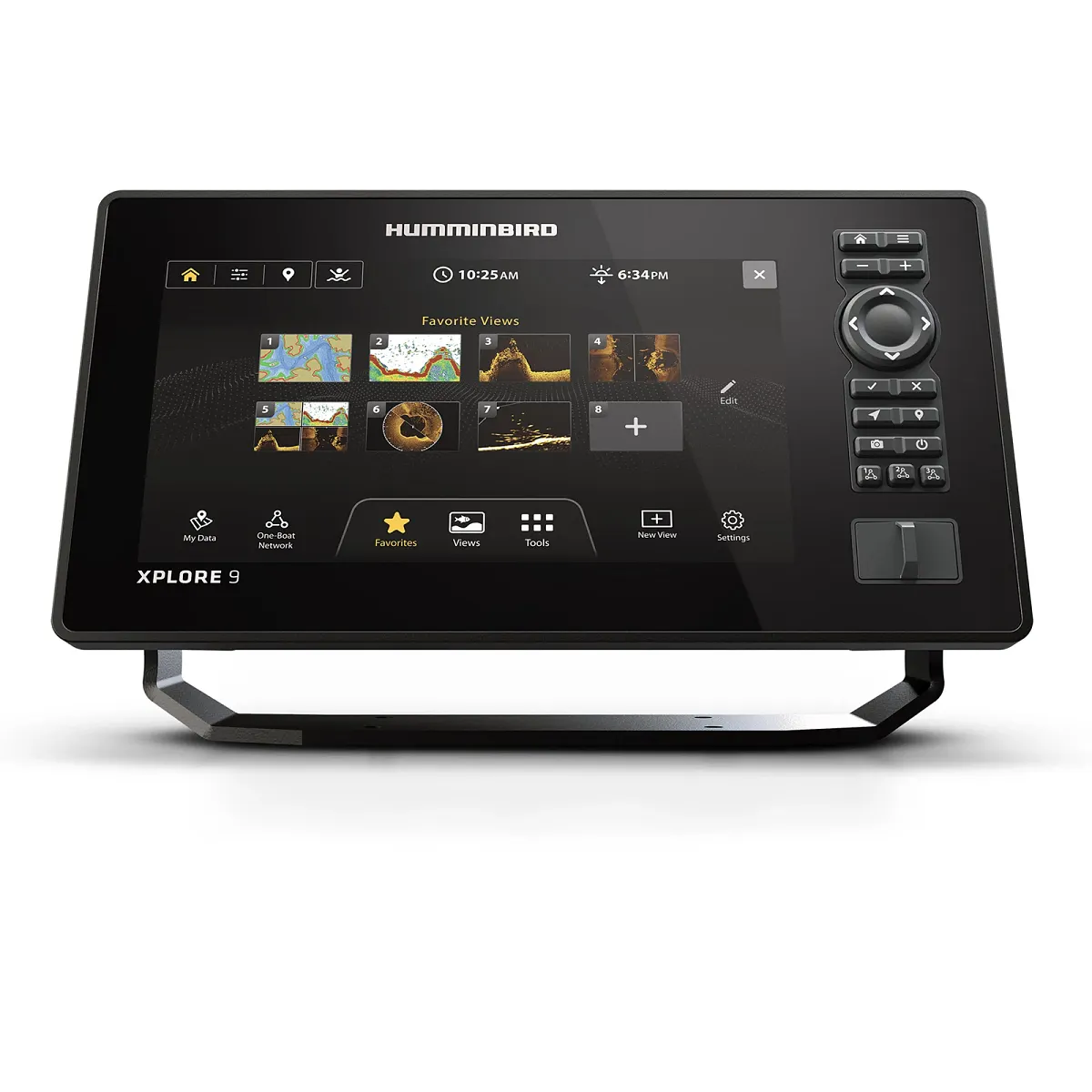
The Humminbird XPLORE 9 (Item 412000-1) ships with the XM 14 HW CMSI T transom-mount transducer and 1,000 W RMS of transmit power. Its standard sonar is rated to 1,200 ft — squarely into deep-drop territory — and to 3,500 ft with an optional 50 kHz accessory transducer fitted. Note the honest detail in its own numbers: that 3,500 ft figure is the accessory transducer’s rating, not the included one. For a full breakdown, see our Humminbird XPLORE 9 review.
Disclosure: DeepDropFishing.com is reader-supported. When you buy through links on our site, we may earn a commission at no extra cost to you. We only recommend gear we would rig ourselves.
Check Price on Amazon — Humminbird XPLORE 9
The Garmin STRIKER Vivid 7sv (part number 010-02553-00) ships with the GT52HW-TM transducer and transmits at 500 W (RMS). Garmin rates it to 800 ft on traditional sonar and 500 ft on its ClearVü and SideVü imaging views. Placed honestly, that makes the STRIKER an excellent mid-depth unit that reaches the shallow end of deep-drop water on traditional sonar — but not a deep-water system in the 1,000 ft-plus sense.
Check Price on Amazon — Garmin STRIKER Vivid 7sv
Frequently Asked Questions
How deep can the Humminbird XPLORE 9 read?
To 1,200 ft with its standard sonar and included transducer, and up to 3,500 ft with an optional 50 kHz accessory transducer.
How deep can the Garmin STRIKER Vivid 7sv read?
With the GT52HW-TM transducer included with the U.S. version, Garmin rates traditional sonar to 800 ft and ClearVü and SideVü imaging to 500 ft.
Why does my fish finder lose the bottom in deep water?
Because the echo runs out of energy on the round trip. High-frequency, wide-cone, lower-power transducers run out sooner; the fix is a lower frequency, a narrower cone, more power, or a cleaner mounting — in that order.
Is the rated maximum depth the depth I can actually fish?
No. The rating is the manufacturer’s maximum for registering the bottom under favourable conditions. Plan your fishing depth comfortably inside the rating, not at it.
What do I need to read the bottom at 1,000 ft or more?
A 1 kW-class system built around a low-frequency CHIRP transducer, a narrow cone, and a clean mounting — the setup described in the 800–1,500 ft row of the table above.
The Bottom Line
However the question is phrased, the answer is the same: a fish finder reads exactly as deep as its transducer and power allow — no further, no matter how large the screen. Match the transducer to the depth you actually fish, and the headline numbers stop being a trap. If you are speccing that transducer itself — the classes, frequencies, and mounts in full — our deep-water transducer guide walks through the whole decision.