
Top 5 Editorial Picks
Five current picks chosen for distinct deep drop needs — from a sonar-first 7-inch unit to a premium expandable system and our top electric reel. These are editorial selections, not ratings.
As an Amazon Associate, we earn from qualifying purchases.
Electric Reel vs Manual Reel for Deep Drop Fishing
Disclosure: DeepDropFishing.com is reader-supported. When you buy through links on our site, we may earn a commission at no extra cost to you. We only recommend gear we would rig ourselves.
Straight Answer
Go electric if you regularly fish deeper than about 600 feet, you make drop after drop all day, or winding heavy lead up by hand is wearing you — or your shoulders, hands, or fishing partners — out. Past a few hundred feet, the retrieve stops being part of the fun and starts being the price of admission, and a motor removes that price. The electric reels we cover below hold 1,000 yards or more of 80-lb braid and pull with 50 lb or more of drag, which is the class of reel built for tilefish, grouper, and other deep bottom fish.
Stay manual if your deep dropping is occasional, your spots sit in a few hundred feet of water or less, or you simply enjoy fighting and winding a fish in by hand and want the simplest, lightest, most affordable setup on the boat. A conventional manual reel has no battery to charge, no cord to manage, and nothing electronic to fail — and in moderate depths it gives up very little.
Neither choice is the “serious” one. The right answer depends on your depth, your drop count, and your body — and this guide walks through each factor honestly.
The Honest Trade-Offs
Depth is the deciding factor
Everything else in this comparison bends around one number: how deep you fish. In a few hundred feet of water, a manual retrieve is a short job, and the weight of the rig coming up is manageable for most anglers. Our best electric reels guide puts the turning point at around 600 feet: past that, cranking a heavy rig back up by hand stops being fun and starts being a workout. Beyond 1,000 feet — prime tilefish and snowy grouper water — every empty retrieve is hundreds of turns of the handle against several pounds of lead, and that cost is paid whether a fish is on or not. An electric reel pays it with a motor instead.
Effort over a full day
One deep retrieve by hand is exercise. Twenty of them is exhaustion. Deep drop fishing is a numbers game: you drop, drift over the spot, retrieve, re-bait, and drop again. With a manual reel, your arms and shoulders are the motor for every one of those cycles, including the empty retrieves when nothing bit and the long winds up from a snag-free drift that produced nothing. Fatigue also creeps into the fun parts — an angler who has been cranking all morning has less left for the fight when a good fish finally eats. An electric reel keeps your energy for the fishing itself: watching the rod tip, working the bite, and handling the fish at the boat.
Number of drops per trip
Closely tied to effort: the more drops you make, the more electric pays off. If your style is a handful of drops on one or two spots, a manual reel’s simplicity is hard to beat. If you prospect — moving spot to spot, checking structure, making short drifts and frequent retrieves — the electric’s push-button retrieve turns each check into seconds of waiting instead of minutes of cranking, and you will fish more spots in a day simply because checking the next one costs you nothing.
Angler mobility and who is holding the rod
This is the factor that never shows up in spec tables, and for many boats it is the real reason to go electric. Anglers with shoulder problems, grip weakness, arthritis, or limited stamina can be effectively locked out of deep water with a manual reel — not because they cannot fish, but because they cannot wind. An electric reel with a simple power lever keeps those anglers in the game at any depth. The same logic applies to kids, older family members, and guests on a charter: the Daiwa Tanacom 1200 is popular on charter boats precisely because its variable-speed power lever and readable line counter are simple enough for the whole crew to run. If your boat regularly carries anglers of mixed strength and experience, electric is not a luxury — it is an access tool.
Power and battery needs
A manual reel needs nothing. An electric reel needs a power plan, and it is fair to count that as a real cost of going electric. The reels we cover run on external power: the Tanacom 1200 runs on 12V DC, with the battery or power supply a separate purchase; the Shimano Forcemaster 9000A runs on an external battery through its included cord, with the battery itself sold separately. That means thinking about boat wiring, connectors, cord management around the deck, and battery capacity for a full day of drops. None of it is difficult, but all of it is one more system to set up and maintain — and one more thing that can end a trip early if it fails. Be honest about whether your boat and your habits suit that, or whether a cord-free setup matters more to you.
Maintenance
A manual reel is gears, bearings, and a drag stack — about as simple as fishing machinery gets, and any competent tackle shop can service one. An electric reel adds a motor, electronics, a display, and power connections that all live in a saltwater environment. The better deep-drop electrics are built for that environment — the Tanacom 1200 uses a sealed electronics package and corrosion-resistant bearings, so it can be washed down after the day — but “sealed and serviceable” is still more upkeep than “rinse and forget.” Expect to rinse carefully, check cords and connectors for corrosion, and follow the maker’s care guidance. In return you get a line counter that always knows how much line is out, and a motor that does the heaviest work on the boat.
Decision Table: By Depth and Fishing Style
| Your fishing | Better fit | Why |
|---|---|---|
| Bottom fishing under ~300 ft, a few drops per trip | Manual | Retrieves are short, the setup is lightest and simplest, and electric’s advantages barely show up at this depth |
| 300–600 ft, occasional deep drop days | Either — lean manual if drops are few, electric if you prospect many spots | This is the crossover zone; your drop count and your shoulders decide it |
| 600–1,000 ft regularly | Electric | Hand-cranking heavy rigs from this depth, all day, is the grind electric reels exist to remove |
| Beyond 1,000 ft — tilefish, snowy grouper, deep structure | Electric | Capacity and sustained winding power matter more than anything else; the electrics below hold 1,000+ yards of 80-lb braid |
| Charter boat or mixed-ability crew | Electric | A power lever and line counter keep every angler fishing, regardless of strength or experience |
| Anglers with limited mobility, grip, or stamina | Electric | Removes the winding barrier entirely while keeping the angler on the rod for the bite and the fight |
| Minimalist, low-maintenance, lowest upfront cost | Manual | No battery, no cord, no electronics — and manual gear costs far less upfront than any serious electric |
Where Each Wins
Where manual wins: simplicity, weight in hand, and price of entry. There is nothing to charge, plug in, or waterproof. Manual gear is also the more connected way to fish — you feel every turn of the fight through the handle — and for anglers whose deep dropping is an occasional change of pace rather than a program, it is honestly all the reel they need. It is also the fail-safe option: a manual reel cannot run out of battery at the far end of a long day.
Where electric wins: depth, volume, and people. Depth, because the motor does not care whether the rig is coming up from 400 feet or 1,400. Volume, because a push-button retrieve makes ten more drops in a day realistic instead of punishing. People, because it opens deep water to anglers who cannot hand-crank it. Add the practical extras — a line counter that tells you exactly how much line is out, so you can return to the same depth on the next drift — and electric becomes less about laziness and more about fishing deep water properly, all day, with whoever is on the boat.
The Electrics We Cover
Disclosure: DeepDropFishing.com is reader-supported. When you buy through links on our site, we may earn a commission at no extra cost to you. We only recommend gear we would rig ourselves.
Daiwa Tanacom 1200 — the proven workhorse
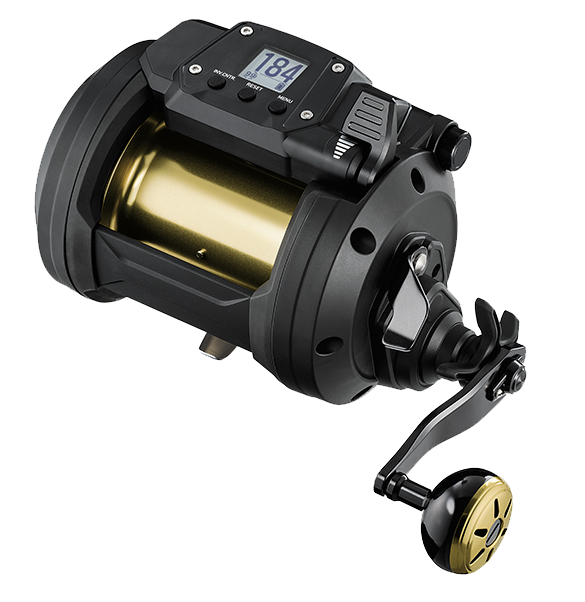
The Tanacom 1200 is Daiwa’s big-capacity electric, built for deep dropping for grouper and tilefish, swordfishing, and kite fishing. It holds 1,100 yards of 80-lb J-Braid, pulls with 50 lb of max drag, and runs on 12V power with a variable-speed power lever — no complicated setup or extra modes to learn before the first drop. The LED dot-matrix display shows a line counter and power-assist prompts, so you always know how much line is out. At 72 oz it is a heavy reel, and you feel that on a long day; what you get in return is the largest line capacity in its class in a simple reel the whole crew can operate. Read the full Tanacom 1200 review.
Shimano Forcemaster 9000A — capacity and speed in a lighter frame
The Forcemaster 9000A (model FM9000A, right-hand retrieve only) pairs 1,030 yards of 80-lb braid with 55 lb of max drag and a fast 153-yards-per-minute winding speed, in a 53.4 oz frame — much lighter in hand than the big Daiwa. Shimano’s Heat Free System II vents motor heat through the side plate, which is designed to hold winding power through repeated drops and long fights, and the Fine Dot LCD shows depth, line out, and reel status in a sunlight-readable display. It runs on an external battery via the included power cord; the battery itself is a separate purchase. Read the full Forcemaster 9000A review.
Shimano BeastMaster 9000B — the flagship step up
Shimano’s flagship electric pairs the lightest full-size package here — 52.4 oz — with 55 lb of max drag, a brushless GigaMax motor, a color Fine Dot LCD, and 1,030 yards of 80-lb PowerPro capacity. Against the Tanacom 1200 it is notably lighter with more max drag, and it costs substantially more. It is the pick for regular deep-drop anglers who want maximum refinement in the lightest frame and are prepared to sort boat power and rigging properly. See the full BeastMaster 9000B review for the complete picture.
For the wider lineup and how these reels compare with the other electrics we track, see our best electric reels for deep drop fishing guide, and our complete deep drop fishing guide if you are building the rest of the setup around the reel.
FAQ
At what depth does an electric reel become worth it?
Around 600 feet is the honest turning point for most anglers: below that, hand retrieves are short enough that a manual reel’s simplicity wins for occasional use; above it, the winding cost of every drop — fish or no fish — starts to dominate the day. Beyond 1,000 feet, electric is close to standard practice for a simple reason: the retrieve is the biggest physical job in the fishery, and a motor does it without wearing out the angler.
Does an electric reel fight the fish for you?
No. The motor’s main job is the retrieve — bringing rigs and fish up from depth at a controlled speed. You still set up on the fish, watch the rod, manage the drag, and handle everything at the boat. What electric removes is the hundreds of empty and loaded turns of the handle between you and the bottom, not the fishing itself.
Can I deep drop with a manual reel at all?
Yes — anglers did it for decades and many still do, especially in a few hundred feet of water. The limits are practical, not absolute: fewer drops per day, more fatigue, and a real ceiling on how deep you can fish comfortably. If your spots are moderate and your days are short, manual is a legitimate choice, not a compromise.
What extra gear does an electric reel need?
Power, above all: the reels covered here run on external batteries — the Tanacom 1200 on 12V DC with the battery a separate purchase, the Forcemaster 9000A on an external battery through its included cord. You will also want a rod built for electric-reel deep dropping and the wiring and connectors to run power safely around the deck. Budget and plan for the power setup as part of going electric, not an afterthought.
Which should a beginner choose?
Start by being honest about where you will actually fish. If your deep dropping will be occasional and in moderate depths, a manual setup keeps things simple and inexpensive while you learn the fishery. If you already know your spots sit in 600 feet or more and you plan to fish them often, going electric from the start saves you buying twice — and saves your shoulders from the first season onward.
The Bottom Line
Manual and electric are not rivals so much as tools for different versions of the same fishery. Shallow, occasional, and simple points to manual. Deep, frequent, and shared with a crew of mixed abilities points to electric — and once your program lives past 600 feet, the motor stops being a luxury and becomes the thing that makes the whole day work. Decide by your depth first, your drop count second, and your crew third, and the choice makes itself.