
Top 5 Editorial Picks
Five current picks chosen for distinct deep drop needs — from a sonar-first 7-inch unit to a premium expandable system and our top electric reel. These are editorial selections, not ratings.
As an Amazon Associate, we earn from qualifying purchases.
Daiwa Tanacom 1000
Disclosure: DeepDropFishing.com is reader-supported. When you buy through links on our site, we may earn a commission at no extra cost to you. We only recommend gear we would rig ourselves.
Quick Answer
The Daiwa Tanacom 1000 is a 12-volt power-assist electric reel from Daiwa’s Tanacom line, built for deep drop and kite fishing. It is a previous-generation model: Daiwa’s big-reel lineup has since moved on to the Tanacom 800 and Tanacom 1200, and the 1000 is no longer the reel Daiwa leads with. Plenty of 1000s are still fishing, and good used examples still change hands — but if you are buying new today, the reel that took its place is the Daiwa Tanacom 1200, which holds more line and is the current model we recommend for the same work.
What the Tanacom 1000 Was
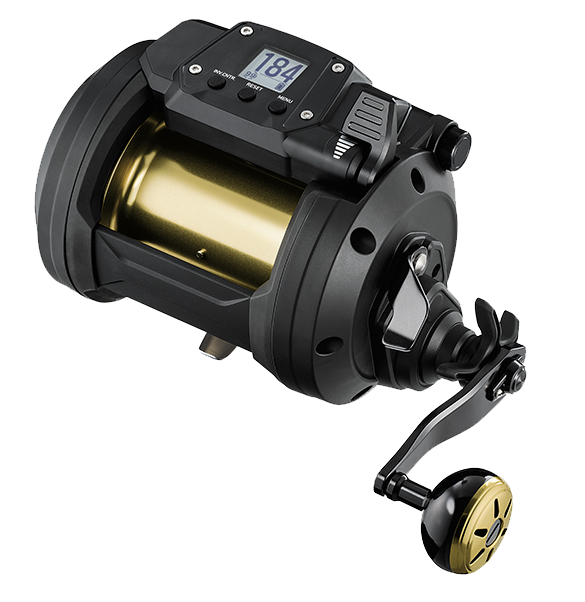
The Tanacom 1000 (Daiwa product code 40801001) was the big-capacity member of Daiwa’s Dendoh-style Tanacom family — the size anglers reached for when the drop was deep, the sinker was heavy, and winding it all back by hand stopped being fun several hundred feet ago. Daiwa’s own description of the reel is simple: fight the fish on the handle, and let the power assist do the drudgery of retrieving heavy sinkers from the depths when it is time to check a bait. It was matched to Dendoh-style deep drop rods and kite rods, and it earned its place on boats doing exactly that work — deep dropping for bottom fish and flying kites offshore.
The specification Daiwa published in the reel’s operating manual tells you what kind of tool it was:
- Gear ratio (manual winding): 2.3:1
- Weight: 1,500 g (53 oz)
- Maximum drag: 22 kg (48 lb)
- Ball bearings: 4
- Power supply: DC 12 V (acceptable range 12–16.8 V)
- Electric current draw: 3 A with no load, 10 A at stall, 30 A maximum
- Winding speed: continuously variable via the Power Lever, up to 140 m/min with no load
- Counters: a depth counter reading 0.0–999.9 m, plus an inverse counter for distance from the bottom
Line capacity is where the 1000 made its name. By Daiwa’s manual figures, the spool takes 1,000 m (1,100 yd) of PE6 braid, 800 m (880 yd) of PE8, or 600 m (660 yd) of PE10. In the pound-test braid terms most US anglers spool by, Daiwa rates it at 880 yd of 80-lb braid. Monofilament capacity is 700 m (770 yd) of 30 lb or 500 m (550 yd) of 40 lb. That is genuine deep-water capacity — enough line to fish well past 1,000 feet with scope for current and drift, which is exactly the fishing this reel was bought for.
Around those numbers, Daiwa built the feature set that defined the Tanacom way of fishing. A variable-speed Power Lever gives one-handed control of winding speed and power. The LCD display reads out in English and shows the line counter with depth memory, so you can drop a bait back to the same depth again and again. A programmable Auto-Stop halts the retrieve at a set point, and there are jigging, chumming-timer, line-feeding, and pickup functions documented in the manual. The line guide aperture is oversized to clear large knots and kite swivels, the electronics package is sealed, the drag system is sealed, and the reel can be washed down after a trip. There is also a manual winding option — the motor is mounted at the front of the reel on this generation, rather than inside the spool as on the later 800 and 1200.
Two smaller touches show how thoroughly the reel was thought through for boat work. The display is backlit for early-morning and night fishing, and a built-in circuit breaker stops automatic winding if the reel is overloaded — snagged on the bottom, for instance — rather than letting the motor cook itself. The inverse counter, meanwhile, tracks distance up from the bottom, so a bait that just got bit can be dropped back to the same zone precisely.
In short: the 1000 was the straightforward, big-spool workhorse of its generation. No touchscreen, no menu maze — a power lever, a counter, and enough line and drag to fish deep all day.
Who Still Runs One — and the Reality of Buying Used
Plenty of Tanacom 1000s are still on boats, and it is not hard to see why. The job has not changed: deep drop fishing still means heavy leads, long retrieves, and bottom fish that live hundreds of feet down. A reel with 880 yards of 80-lb braid capacity, 48 lb of drag, and a simple power-lever layout still does that job. Owners who bought one new have little reason to retire a reel that keeps working, and on charter and private boats alike, a 1000 that has been washed down, stored with the drag loosened (as Daiwa’s manual advises), and fed clean 12-volt power can keep earning its spot. If your fishing lives in the depths covered by our deep drop gear and rigs guide, a healthy 1000 covers the same water it always did.
Buying one used takes clear eyes, though. This is an electric reel, which means the motor, the circuit board, and the power cord are all wear items in a way a conventional reel’s parts are not. Before money changes hands, power the reel up: the display should light, the counter should read, and the motor should run smoothly through the Power Lever’s range without grinding, surging, or cutting out. Daiwa’s manual is blunt about the cord — old or worn cords cause bad connections and short circuits, and Daiwa advises replacing the cord every two years — so inspect the cord and connector closely and figure a replacement cord into your thinking if it looks tired. Check the drag for smoothness, the levelwind for even travel, and the spool for corrosion. A reel that cannot be powered up for inspection is a gamble, not a bargain, whatever the asking terms.
Parts and service are the other half of the used equation. Daiwa’s operating manual for the 1000 includes a full parts list and directs owners to a dealer for parts and service, which is the right first call for any 1000 that needs work. But set expectations honestly: it is a discontinued-generation reel, and long-term support for ageing electronics is never guaranteed. That is not a reason to walk away from a clean example at the right terms — it is a reason not to pay current-model money for one.
Buying Today?
If you like everything about the Tanacom 1000 but want a reel that is current, supported, and sold new with a warranty, Daiwa has already built it. The Tanacom 1200 is the current big-capacity Tanacom, and Daiwa’s own launch comparison makes the succession explicit: the 1200 holds 1,100 yards of 80-lb J-Braid — 220 yards more than the 1000’s spool. It keeps the same family layout deep drop anglers know — 12-volt power, a variable-speed power lever, a line counter on an LED dot-matrix display with selectable languages — and adds 50 lb of max drag in a heavier 72 oz frame built for deep drops, swordfishing, and kite fishing. Our Tanacom 1200 review covers it spec by spec, and it also sits in our roundup of the best electric reels for deep drop fishing, if you want to see how it stacks up against the rest of the field before you decide.
Disclosure: DeepDropFishing.com is reader-supported. When you buy through links on our site, we may earn a commission at no extra cost to you. We only recommend gear we would rig ourselves.
Stepping up a class? Our Kraken X 5000 vs Tanacom 1200 comparison shows where Daiwa’s bigger 1200 sits against Piscifun’s budget challenger.
FAQ
Is the Tanacom 1000 still made?
It is a previous-generation model. Daiwa’s current big Tanacom reels are the 800 and 1200, and the 1000 is no longer the reel Daiwa sells as its big-capacity option — new stock, where it appears at all, is leftover rather than current production. The used market is where most 1000s change hands now.
Tanacom 1000 vs 1200 — what’s different?
The headline difference is capacity: 880 yards of 80-lb braid on the 1000 against 1,100 yards of 80-lb J-Braid on the 1200 — Daiwa itself quotes the 220-yard gap. The 1200 also edges the drag (50 lb vs. 48 lb), weighs more (72 oz vs. 53 oz), and gears slightly lower (2.1:1 vs. 2.3:1). The layout will feel familiar to any 1000 owner: 12-volt power, a variable-speed power lever, and a line counter. The full side-by-side is in our Tanacom 1200 review.
Can a Tanacom 1000 still be serviced?
Daiwa’s manual for the reel includes a complete parts list and refers owners to Daiwa dealers for parts and service, so a dealer is the right first stop. Because the reel is a discontinued generation, though, go in expecting that some parts — especially electronics — may be limited, and confirm a part is actually available before buying a reel that already needs it.
What power does the Tanacom 1000 need?
A 12-volt DC source. Daiwa specifies an acceptable range of 12–16.8 V, with current draw of 3 A under no load, 10 A at stall, and up to 30 A at maximum. The battery or boat supply is a separate item — the reel does not run on its own internal battery.
How much line does a Tanacom 1000 hold?
By Daiwa’s manual: 1,100 yd of PE6 braid, 880 yd of PE8, or 660 yd of PE10 — and 880 yd when spooled with 80-lb braid in US terms. That is enough for deep dropping well beyond 1,000 feet, with line to spare for the angle of the drop.