
Top 5 Editorial Picks
Five current picks chosen for distinct deep drop needs — from a sonar-first 7-inch unit to a premium expandable system and our top electric reel. These are editorial selections, not ratings.
As an Amazon Associate, we earn from qualifying purchases.
Best Transducer for Deep Drop Fishing
Disclosure: DeepDropFishing.com is reader-supported. When you buy through links on our site, we may earn a commission at no extra cost to you. We only recommend gear we would rig ourselves.
Quick Answer
For deep drop fishing in 600–1,500 feet of water, the transducer class that works is a 1 kW-class, low-frequency CHIRP transducer in a thru-hull or flush mount — low frequency (around 50 kHz) for depth penetration, high power to drive the signal down and back, and a narrow cone angle to concentrate that energy under the boat. Most transducers bundled with fish finders — including good ones — are built for shallow and mid-depth work and simply run out of signal long before the bottom at deep-drop depths. If your fishing is mostly inside 300 feet, a quality bundled transom transducer is fine. If your baits land at 800 feet and beyond, the transducer, not the screen, is the part of the system you need to upgrade.
How a Transducer Works at 1,000 Feet and Beyond
A transducer is the part of your sonar system that lives in the water. It converts electrical pulses from your fish finder into sound waves, sends those waves down through the water column, and then listens for the echoes that bounce back from the bottom, structure, and fish. Your display unit only draws the picture — the transducer decides how much information exists to draw with.
That distinction matters little in 60 feet of water. It matters enormously at 1,000 feet, for three reasons.
First, the signal weakens on the way down and on the way back. Sound energy spreads out and is absorbed by the water as it travels. An echo returning from 1,200 feet has made a 2,400-foot round trip, and only a fraction of the original energy makes it back to the transducer face. Whatever is left has to be strong enough to register as bottom, structure, or a fish mark.
Second, frequency decides how deep the sound can usefully go. Lower frequencies are absorbed more slowly and travel farther in water; higher frequencies deliver finer detail but give up range. This is why a high-frequency imaging signal that paints a beautiful picture at 80 feet cannot reach the bottom at 900 feet — the energy is spent long before it gets there.
Third, power and cone angle decide how much energy arrives. Transmit power is the size of the “shout.” A 1 kW transducer shouts far louder than a unit built for a few hundred watts, and that extra energy is what still has something left after a 2,000-foot round trip. Cone angle is the shape of the shout: a narrow cone concentrates the same power into a smaller column of water, pushing it deeper, while a wide cone spreads it thin across a broad area — excellent for covering water in the shallows, a liability at depth.
There is one more modern wrinkle: CHIRP. A traditional transducer pings at a single frequency. A CHIRP transducer sweeps across a band of frequencies during each pulse. The sweep puts more total energy into the water and lets the system separate targets more cleanly — better definition of fish holding tight to bottom structure, which is exactly the picture a deep drop angler needs when deciding whether to send a rig down.
Put together, the deep-water recipe is simple to state: low frequency, high power, narrow cone, CHIRP where your sounder supports it. Every buying decision in this guide is an application of those four words.
Frequency and Power: The Deep-Water Table
Use this table as the reference for the rest of the guide. It describes classes of transducers, not individual products.
| Setup | Frequency behaviour | Practical depth character | Best use |
|---|---|---|---|
| 200 kHz traditional | High single frequency, fine detail | Shallow to mid-depth; energy fades well before deep-drop bottom | Bays, reefs, and structure inside a few hundred feet |
| 50 kHz traditional | Low single frequency, coarse detail | The deep-reaching end of classic sonar; built for depth over detail | Deep bottom fishing where simply holding bottom is the job |
| 50/200 kHz dual frequency | Low band for depth, high band for detail | Lets you run the deep band offshore and the detail band inshore | Boats that fish both shallow and deep on the same unit |
| High-wide CHIRP (bundled imaging transducers) | Sweeps a high band with a wide cone | Excellent coverage and imaging in shallow-to-mid depths; not a 1,000 ft tool | General fishing, down/side imaging, marking spots in moderate water |
| Low-frequency CHIRP, 1 kW class | Sweeps a low band with high transmit power | The standard recipe for reading bottom at 1,000 ft+ | Deep drop fishing, deep bottom fishing, offshore wreck work |
| Low-frequency CHIRP, 2–3 kW class | Same low-band logic with two to three times the power | Maximum depth headroom and the strongest deep returns | Serious deep programs, very deep water, larger offshore boats |
Two patterns are worth memorising. Depth comes from the low band — every row that reaches deep-drop water is built around low frequency. And power scales the whole system: moving from a bundled transducer to the 1 kW class is the single biggest depth upgrade most boats can make, and the 2–3 kW class exists for anglers who regularly fish the deepest end of the range.
Thru-Hull vs Transom-Mount vs In-Hull: The Mounting Decision
Frequency and power decide whether the signal can reach the bottom. The mount decides how clean the signal path is — and how much turbulence, aeration, and noise corrupt it on the way.
| Mount | How it works | Strengths | Limits | Choose it if… |
|---|---|---|---|---|
| Transom-mount | Bracketed to the transom, sitting in the water behind the hull | Simplest install, no hole in the hull, easy to adjust or replace | Exposed to turbulence and aerated water at speed; can lose bottom on plane | You trailer the boat, fish moderate depths, or want the easiest install |
| Thru-hull / flush | Fitted through or flush with the hull bottom, face in clean water under the boat | Cleanest water flow of any mount, holds bottom at speed, the natural partner for a 1 kW+ deep-water transducer | Requires cutting the hull; professional install recommended; boat usually needs to be hauled | You deep drop seriously and want the best deep signal the boat can produce |
| In-hull (shoot-through) | Mounted inside the hull, firing through solid fibreglass | No hole, nothing exposed outside, protected from damage | Loses some power through the hull; cannot do side imaging | Your hull is solid fibreglass, you only need traditional/down sonar, and you accept some signal loss |
For a dedicated deep drop boat, the decision is usually settled by the transducer class itself: serious 1 kW low-frequency CHIRP transducers are overwhelmingly thru-hull units, because that is where they perform best. Transom mounts remain the right answer for the huge range of fishing that happens in moderate depths — and, as the picks below show, the bundled transom transducer on a modern fish finder is a genuinely capable piece of gear inside its depth class. In-hull is the compromise mount: invisible and protected, but you pay for it in signal, and it rules out side imaging entirely.
Our Picks: The Right Class for Your Depth
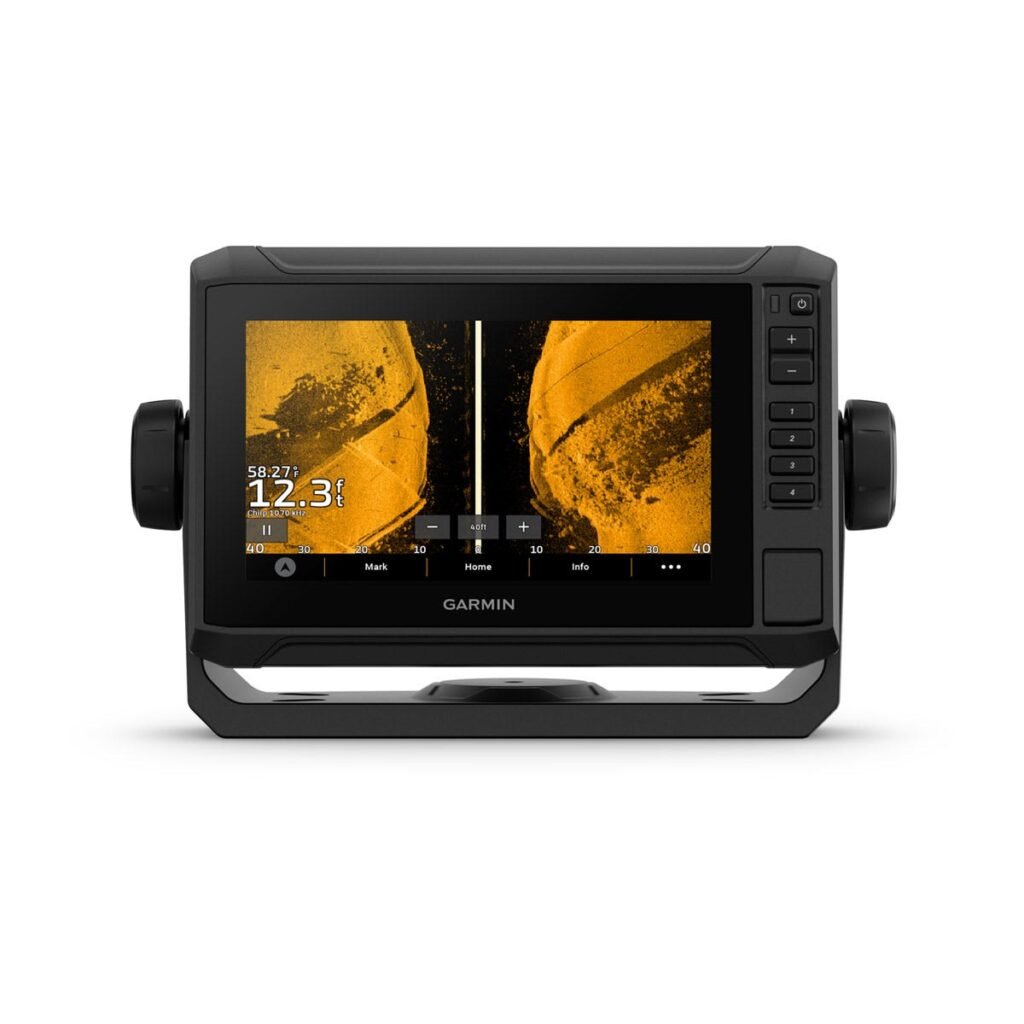
We recommend by class first, then show you the two concrete transducers we have documented on this site — one as the honest example of the mid-depth class, and one as a system that reaches genuinely deep.
Pick 1 — For 1,000 ft and beyond: 1 kW low-frequency CHIRP, thru-hull
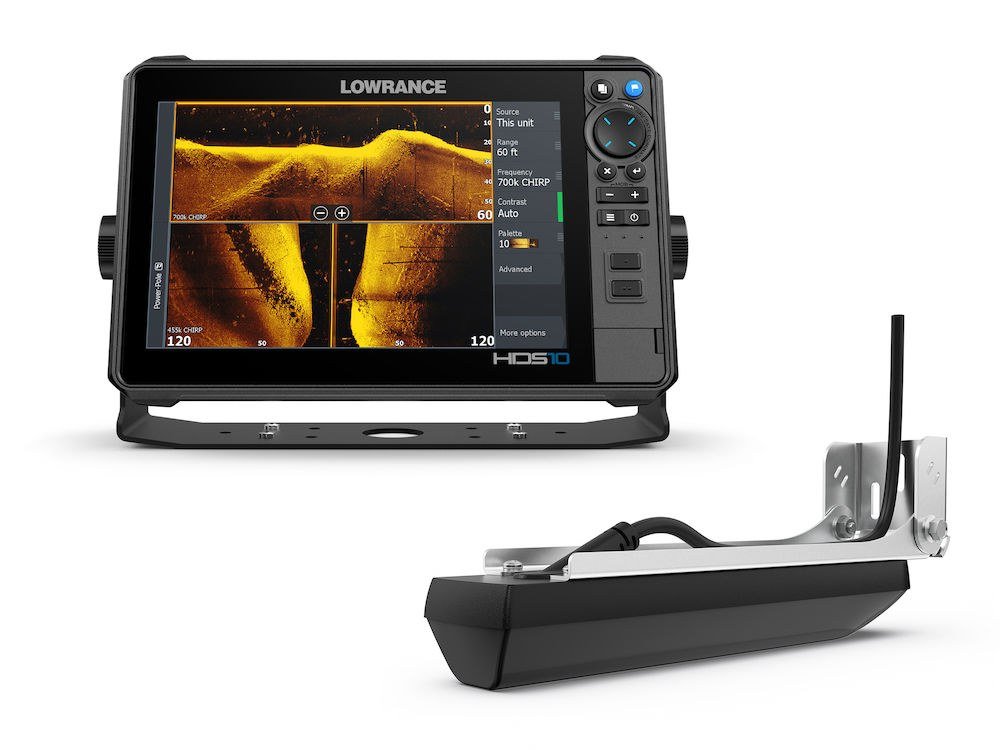
This is the deep drop standard. A 1 kW-class low-frequency CHIRP transducer in a thru-hull mount is the first setup that reads bottom at 1,000 ft+ with energy to spare — enough to separate fish from structure instead of painting one merged blob. If you regularly fish 800–1,500 feet for tilefish, grouper, or wreck species, this is the class to build around, paired with a sounder that can drive it. Anglers fishing the deepest water, or who simply refuse to ever lose bottom, step up to the 2–3 kW class of the same recipe.
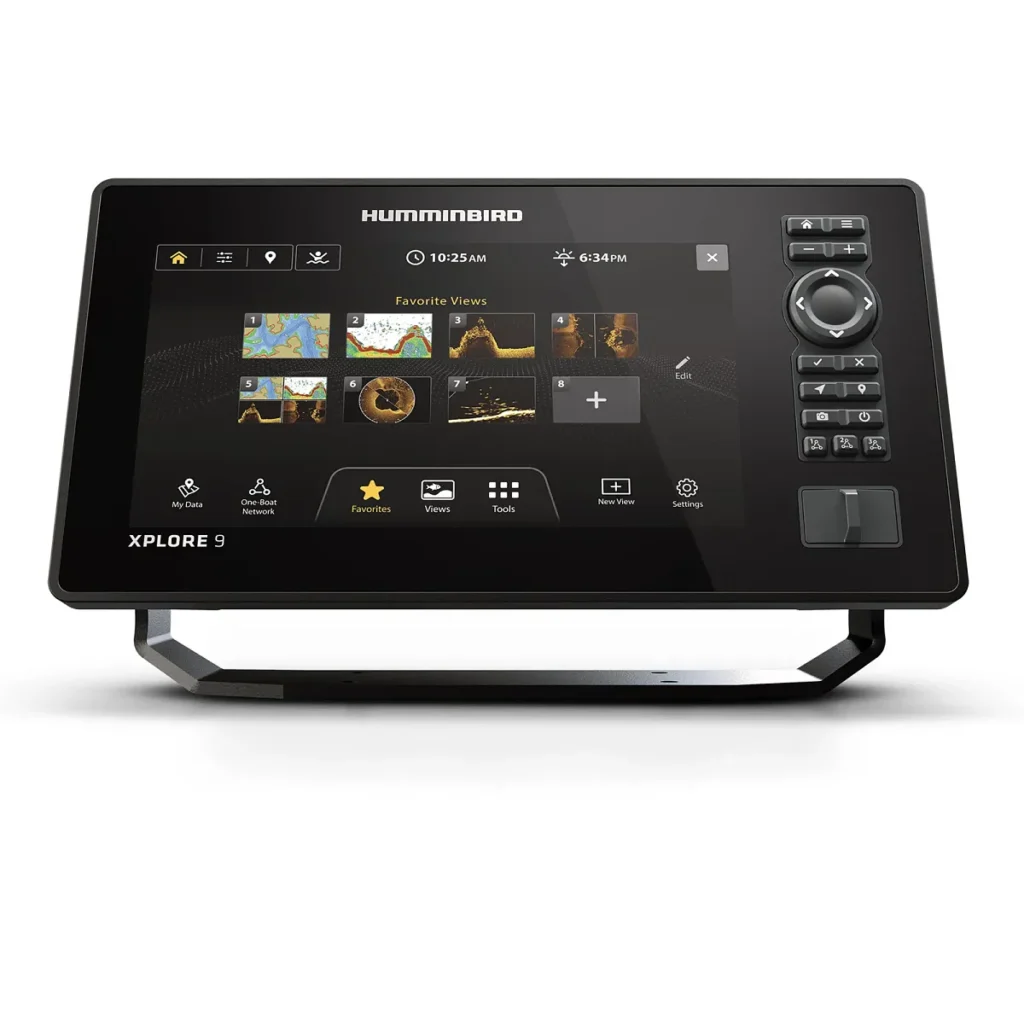
Pick 2 — The off-the-shelf deep-capable system: Humminbird XPLORE 9 with XM 14 HW CMSI T
The concrete named example on this site of a system that reaches deep is the Humminbird XPLORE 9, which ships with the XM 14 HW CMSI T transducer (the XPLORE 9 package is Item 412000-1). The transducer supports Dual Spectrum CHIRP alongside MEGA Side Imaging+ and MEGA Down Imaging+, and the system reads to 1,200 feet in standard form — and up to 3,500 feet when paired with an optional 50 kHz accessory transducer. That optional low-frequency accessory is exactly the principle from the table above applied by the manufacturer: when the standard setup reaches its limit, the fix is a 50 kHz transducer. For the full breakdown of the unit, read our Humminbird XPLORE 9 review.
Check Price — Humminbird XPLORE 9 on Amazon
Pick 3 — For shallow-to-mid-depth fishing: the bundled transom class (Garmin GT52HW-TM)
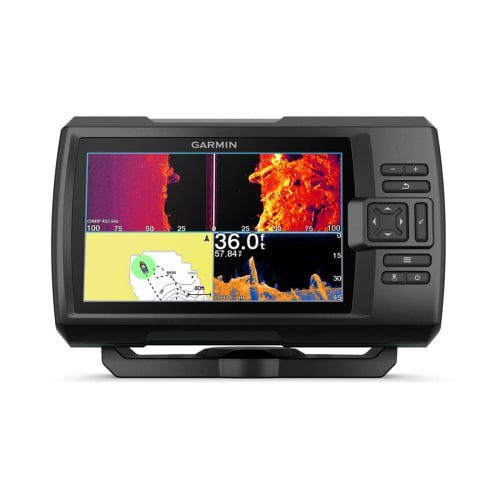
The honest example of the other end of the scale is the Garmin GT52HW-TM, the transom-mount transducer included with the US-model Garmin STRIKER Vivid 7sv (model 010-02553-00). It is a high-wide CHIRP transducer covering traditional sonar plus ClearVü and SideVü imaging — a well-specced unit for its job, which is shallow-to-mid-depth fishing: marking spots, scanning structure, and covering water where most recreational fishing happens. What it is not is a deep-drop transducer; its class runs out of signal long before 1,000 feet. We include it deliberately: most anglers do not need Pick 1, and buying deep-water power for 150-foot fishing is wasted money. Our full take is in the Garmin STRIKER Vivid 7sv review.
Check Price — Garmin STRIKER Vivid 7sv on Amazon
Not sure which class your fishing falls into? Our gear pillar walks through the full deep-drop setup — rods, reels, rigs, and electronics — in the deep drop fishing gear and rigs guide. For the display side of the system, see our Best Fish Finder for Deep Drop Fishing guide.
Frequently Asked Questions
1. Why does my fish finder lose the bottom in deep water?
Because the transducer’s signal runs out of energy before the echo makes the full round trip. High-frequency, wide-cone, lower-power transducers — the kind bundled for general fishing — spread their energy thin and lose it to the water column. In deep water the fix is the deep recipe: lower frequency, more transmit power, and a narrower cone concentrating the signal under the boat.
2. Can a transom-mount transducer work for deep drop fishing?
The mount is not the main limit — the transducer class is. A transom mount is the simplest install and works well in moderate depths, but serious deep-water transducers (1 kW low-frequency CHIRP) are typically thru-hull units, because the flush hull position gives them the cleanest water flow and lets them hold bottom at speed. Match the class to your depth first, then the mount to your boat.
3. What does CHIRP actually do?
Instead of pinging at one fixed frequency, a CHIRP transducer sweeps across a band of frequencies in every pulse. That puts more energy in the water and gives the system finer target separation — fish sitting tight on deep structure show as distinct marks instead of merging into the bottom return. At deep-drop depths, that separation is the difference between dropping on a mark and dropping on a guess.
4. How much power do I need for 1,000 feet?
The 1 kW class is the recognised step into genuine deep water — it is the power level around which low-frequency CHIRP transducers for 1,000 ft+ are built. Anglers who fish the deepest end of the range, or want maximum headroom, move to the 2–3 kW class. Below the 1 kW class, expect most transducers to be shallow-to-mid-depth tools regardless of what the display unit can do.
5. Do I need to replace my fish finder, or just the transducer?
Often just the transducer — but the pair must be compatible. A deep-water transducer only delivers its depth if the sounder can drive its frequency band and power class, and imaging features like side imaging depend on the transducer supporting them. Check your unit’s supported transducer classes before buying, and remember the reverse also holds: a premium display cannot make a shallow-class bundled transducer reach 1,000 feet.
The Verdict
Deep drop fishing is won or lost at the transducer face. Screens, charts, and menus all sit downstream of one question: does enough sound energy reach the bottom at 1,000 feet and come back with a story to tell? Answer it with the deep recipe — low frequency around 50 kHz, 1 kW of power or more, a narrow cone, CHIRP, and a thru-hull mount — and the rest of your electronics can finally do their jobs. Fish shallower water, and the honest answer flips: a quality bundled transom transducer like the GT52HW-TM class is the right tool, and deep-water power is money spent for nothing. Buy for the deepest water you actually fish, not the deepest water you can imagine.