To tie a deep drop chicken rig, you build a short heavy-mono backbone, hang 3–5 short gangions off it, put a non-offset circle hook on each drop, and finish with a snap so you can change the sinker. Once you’ve done it a couple of times, a rig takes about 10–15 minutes. Pre-tie several at home. Tying 80-pound mono in a swell is how you bleed.
If you still need the difference between a chicken rig, a stiff rig, and a dropper, start with chicken rig vs stiff rig vs dropper. This page is the build.
Quick answer
Cut about 7 feet of 80–100 lb stiff mono. Space 3–5 three-way swivels (or dropper loops) 12–18 inches apart. Hang a 6–10 inch 80 lb gangion from each one. Tie on a non-offset circle hook. Put a barrel swivel at the top for your braid, and a sinker slide with a snap at the bottom so you can swap 1–5 lb of lead without retying the whole thing.
What you’ll need (US tilefish / grouper spec)
This parts list is a working spec for golden tilefish and snowy grouper in typical U.S. offshore water — hundreds of feet, not a 40-foot wreck. Check hook-count rules for your fishery before you build a five-hook rig. Some federal zones cap you at three hooks.
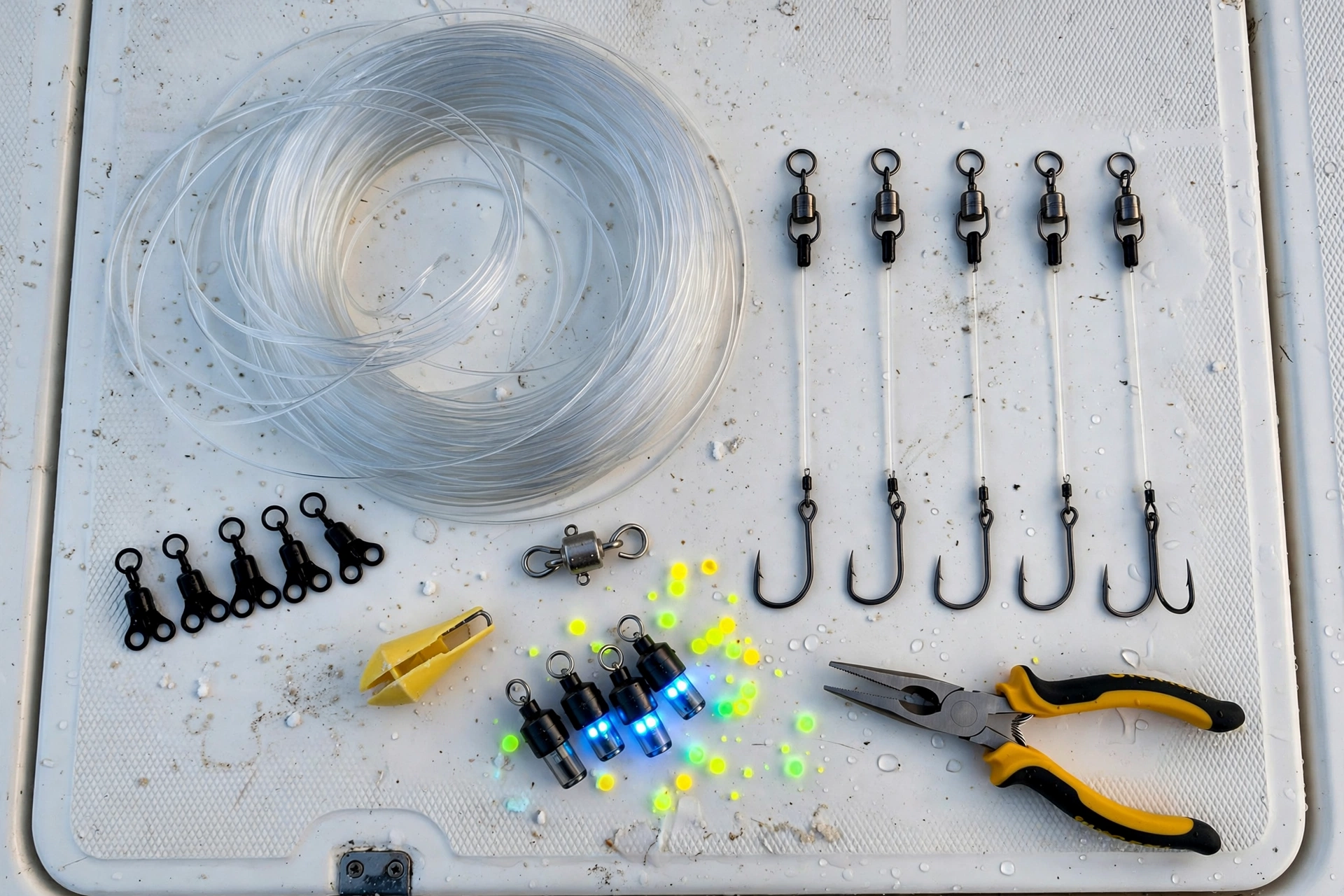
| Item | Working spec | Why |
|---|---|---|
| Mainline (backbone) | 7 ft of 80–100 lb stiff mono or fluoro | Stiff line stands out instead of wrapping. Heavy line takes abrasion on the bottom. |
| Gangions | 3–5 pieces of 80 lb stiff mono. About 6 in for a 5-hook rig; 8–10 in for a 3-hook rig | Short and stiff so baits sit out at about 90 degrees instead of folding in. |
| Hooks | Non-offset circle hooks. 7/0–8/0 for tilefish; 8/0–9/0 for grouper | Non-offset circles are required in many U.S. federal reef-fish fisheries. Confirm today’s rule. |
| Swivels | 3-way swivels, 80–100 lb, one per gangion — or dropper loops in the backbone | Three-ways keep drops from spinning around the mainline. Loops are cheaper and faster. |
| Top connection | 100 lb barrel swivel | Ties to your 80–100 lb braid. Don’t use braid for the rig body itself. |
| Bottom | Sinker slide and a coastlock snap | Change 1–5 lb of lead without cutting the rig. |
| Optional attractors | Glow beads. Small green lights if you want them | It’s dark below a few hundred feet. Beads are cheap. Lights are extra, not the reason the rig works. |
| Tools | Pliers, marker, tape measure, rig board | Build at the dock or at home. Not in a 3-foot swell. |
Dropper loop or three-way swivel?
You can hang gangions two ways. Both are legal chicken rigs. They are not the same job.
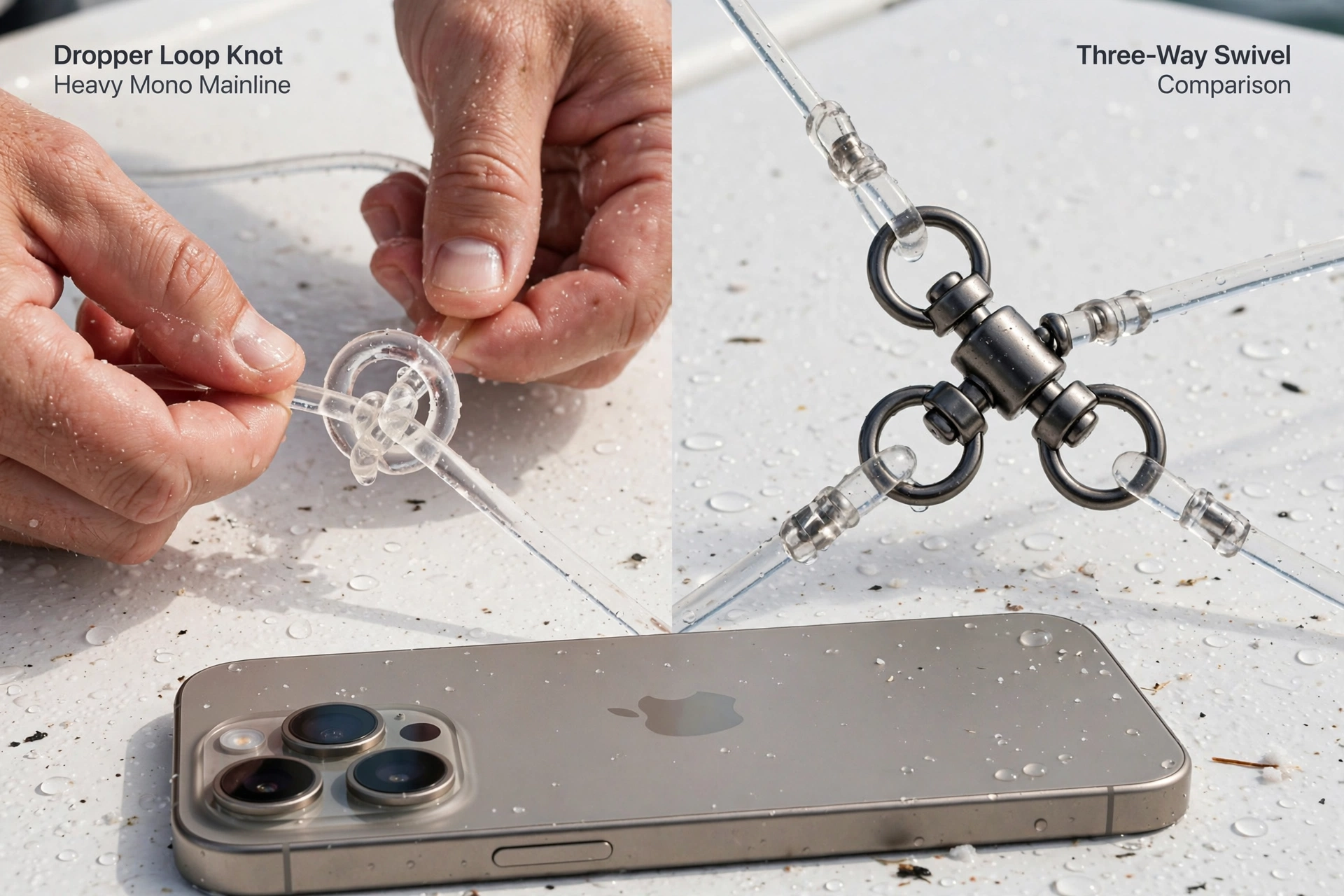
Dropper loop. You tie a loop in the backbone and hang the hook from that loop. Fast. Cheap. Fine for a 3-hook prospecting rig. On 80–100 lb mono the loop is bulky, and long loops wrap the mainline on the way down.
Three-way swivel. The backbone runs through two eyes. The gangion hangs off the third. Drops stand out more consistently. That is the better default for a 5-hook tilefish string you will reuse.
Pick one method and stay with it on a given rig. Mixing loops and swivels on the same backbone is how you get a bird’s nest at 800 feet.
Step 1: Cut and mark the backbone
Cut 7 feet of 80–100 lb stiff mono or fluoro. Do not use braid for this section — it wraps too easily.
Leave about 18 inches at the top for the barrel swivel and 18 inches at the bottom for the sinker slide. Mark the gangion points in between, 12–18 inches apart. Even spacing is what keeps hooks from catching each other on the drop. Closer than a foot and they tangle. Much wider and you miss the strike zone right off the bottom.
Step 2: Hang the gangions
At each mark, either:
- crimp or tie in a 3-way swivel and attach an 80 lb gangion to the free eye, or
- tie a short dropper loop and hang the hook from the loop.
Keep gangions short: about 6 inches on a 5-hook rig, 8–10 inches if you only run three hooks. If two hooks can reach each other when you lay the rig flat, they will tangle in the water. Recut.
Step 3: Tie on the hooks
Use non-offset circle hooks. 7/0–8/0 is the usual tilefish size. Step up to 8/0–9/0 if you are targeting snowy grouper. A uni knot or an improved clinch both hold on 80 lb mono. Cinch it wet, then trim the tag close so it does not pick up bait or line on the way down.
If you use glow beads, slide one on the gangion above the hook before you finish the knot. They are a cheap way to put a little light next to the bait. Small clip-on lights are optional. If you run them, keep them on the backbone or the gangion — not swinging loose where they can wrap a hook.
Step 4: Top swivel and the lead
At the top, tie or crimp a 100 lb barrel swivel. That is what your braid connects to.
At the bottom, put a sinker slide and a coastlock snap — not a weight tied in forever. Current and depth change. A 2 lb sinker that ticks mud in a slack tide will kite in the Stream. Swap lead; don’t rebuild the rig.
Start around 2 lb. If you cannot feel bottom, or the line is standing out at 45 degrees, go up a pound at a time. In current you may need 3–5 lb, sometimes more. Too little lead and you are not deep dropping. You are dragging.
Step 5: Store it so it still fishes
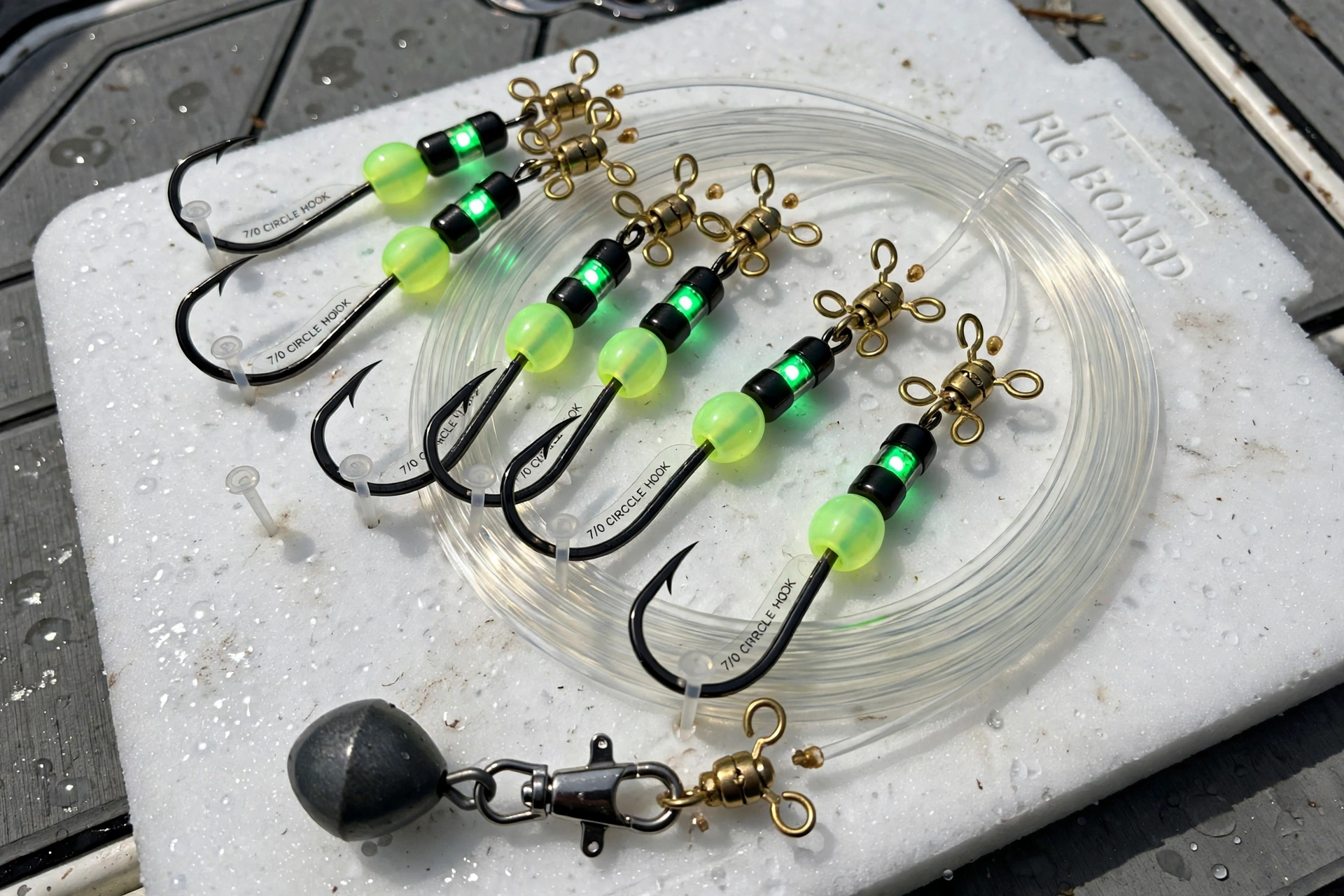
Wind the rig on a foam board or a pool noodle. Pin or tape the hooks. Never coil it in your hand and stuff it in a tote. A rig that tangles in storage will tangle on the drop, and you will not know until you wind 800 feet of empty braid.
Pre-tie more than one. You will hang a wreck. That is normal.
Common mistakes
- Gangions too long. They wrap the backbone. Keep them under about 10 inches.
- Hooks too close. If they can touch on the bench, they will tangle in the water.
- Braid as the rig body. Use stiff mono or fluoro for the 7-foot section.
- Offset or J-hooks. Circles are the standard, and non-offset is the rule in a lot of federal water.
- Lead tied in permanently. Use a snap. You will change weight.
- One rig, no spare. Deep wrecks eat terminal tackle.
FAQ
How many hooks should a chicken rig have?
Three to five is typical. Five is common for tilefish. Three is common for bigger grouper so you are not hanging two legal-limit fish at once. Some U.S. zones cap you at three hooks. Read the current rule for your water.
Dropper loop or three-way swivel?
Loops are faster. Three-ways usually tangle less on a long drop. For a reusable 5-hook tilefish rig, start with three-ways.
What knot for the hooks?
A uni knot or improved clinch on 80 lb mono. Cinch it wet. Trim the tag. Pull it before you bait it.
Can I build these at home?
Yes. That is the point. Build several, store them on a board, and swap a fresh one when a hook dulls or a gangion chafes.
Do I need glow beads or lights?
No. The rig works without them. Beads are cheap and common below a few hundred feet because it is dark. Lights are extra. Do not treat them like a secret bait.
What this is not
This is not a shop list. It is the rig most people actually drop for tilefish and grouper. For when to use a stiff rig instead, see chicken rig vs stiff rig. For the drop itself, see how to deep drop fish.
Hook limits, circle-hook rules, and gear restrictions change with the fishery and the season. Check current FWC and NOAA rules for your water before you fish.
Keep Reading
- Deep Drop Fishing Rigs: Chicken Rig vs Stiff Rig vs Dropper Rig [2026 Guide]
- Deep Drop Fishing Gear: The Complete Beginner Setup
- How to Deep Drop Fish
About DeepDropFishing.com
DeepDropFishing.com is run by Bala, an offshore angler who started with deep drop fishing — electric reels, heavy tackle, and bottom fish in hundreds of feet of water — and now covers offshore and onshore fishing too. The site publishes clear, practical guides on gear, rigs, and technique. It is an independent information site; we do not sell trips or charters.