Deep Drop Fishing

Clear guides on deep drop fishing — information only, no charters

Deep Drop Fishing Rigs: Chicken Rigs, Stiff Rigs, and Dropper Rigs Explained

Deep drop fishing rigs come in three main styles — the chicken rig, the stiff rig, and the dropper rig — each built to hold multiple baited hooks steady in 500 to 1,200+ feet of water while resisting current and tangles. After more than 20 years dropping off Miami, Pulley Ridge, and now the deep ledges off Port Blair in the Andaman, I can tell you this: at 1,000 feet, your rig is doing 90% of the fishing. You can’t feel it. If it tangles on the way down, you just wasted a 30-minute drop and $8 in lead.

Picking the right deep drop fishing rig depends on three things: current speed, bottom type, and how deep you’re fishing that day. This guide breaks down exactly how each rig works, the exact specs I tie, when to use it, and how to build a tangle-free version yourself.

Table of Contents

  • Why Rig Choice Matters in Deep Drop Fishing
  • The Chicken Rig for Deep Drop Fishing
  • Stiff Rig Deep Drop: The Anti-Tangle Weapon
  • The Dropper Rig: Fast and Simple
  • Which Rig Should You Use?
  • How to Build a Basic Deep Drop Rig (Step-by-Step)
  • Gear You’ll Need & Common Mistakes
  • FAQ

    Why Rig Choice Matters in Deep Drop Fishing

    At 500+ feet you have zero visual feedback. You’re fishing blind on braid with an electric reel screaming. Two things kill you: spin and tangle.

    If your baits wrap around the mainline on the drop, no tilefish or grouper will touch it. You won’t know until you crank up 1,000 feet of line.

    Here’s how I choose:

    Bottom Type: Golden tilefish live on soft mud at 600-900 ft. They want baits just off the bottom, spaced wide. Snowy grouper and yellowedge grouper live on hard, rocky ledges at 600-1,200 ft. They need a rig that stays vertical and doesn’t snag.

    Current: In 0.5-1.5 knots, a standard chicken rig for deep drop fishing is perfect. In 2+ knots of Gulf Stream or Andaman current, that same rig helicopters and twists. That’s when you need a stiff rig deep drop setup with a wire backbone.

    Drift: If you’re drifting fast, you need heavier weight (3-5lb) and a rig that holds baits at 90-degrees away from the mainline. If you’re anchored or spot-locked, a simple dropper rig is faster to re-bait.

    My rule: Start with a chicken rig. If you’re getting twisted leaders more than twice a trip, switch to stiff. If you’re prospecting new numbers and losing rigs on rocks, switch to cheap dropper rigs.


  • The Chicken Rig for Deep Drop Fishing

    This is the standard. 90% of charter boats from Islamorada to Port Blair run this. It’s called a “chicken rig” because back in the day you could catch a whole coop full of fish in one drop.

    The Build:

    • Mainline: 6-8 ft section of 150-200lb monofilament or 200lb fluorocarbon. Don’t use braid for the rig body — it tangles too easily.
    • Gangions: 4-5 drops, each 8-12 inches long, made from 50-80lb fluorocarbon. I use 60lb for tilefish, 80lb for grouper.
    • Spacing: 16-18 inches between each gangion. Any closer and you will tangle. Any wider and you miss the strike zone.
    • Connection: 3-way swivels (size 5/0) or 200lb barrel swivels with crimps. I prefer crimped 3-ways — dropper loops weaken under heavy weight.
    • Hooks: Non-offset circle hooks. 6/0-8/0 for Golden Tilefish and Blanquillos, 10/0-12/0 for Snowy and Warsaw grouper. Add a small green glow bead and 1-inch glow sleeve above each hook.
    • Weight: 2-4lb torpedo or bank sinker at the bottom. Rule of thumb: 1lb per 200ft + 1lb per knot of current.

    Best for: General bottom fishing for Golden Tilefish, Snowy Grouper, Yellowedge Grouper, and large Rose Snapper in moderate current (0.5-1.5 knots), 500-1,000 ft.

    Why anglers use it: It’s forgiving, easy to re-tie boat-side, and catches multiple fish. I pre-tie 10 before a trip and store them on a foam rig board.
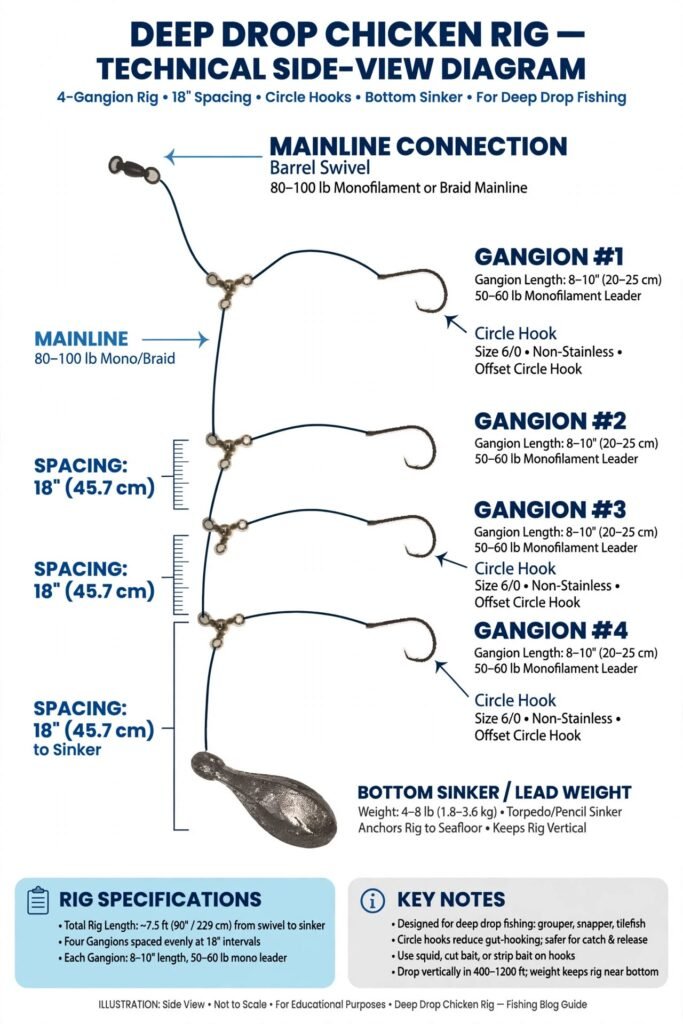
    Diagram of a deep drop chicken rig showing 4 gangions with circle hooks spaced 18 inches apart and bottom sinker for tilefish fishing
    deep_drop_chicken_rig_diagram

    Pro Tip: Don’t use stainless hooks. If you get hung on the bottom at 900 ft, you want the hook to straighten and save your $15 rig. Use light-wire Mustad 39960D or Gamakatsu 208

Stiff Rig Deep Drop: The Anti-Tangle Weapon

This is the rig that saved me when I started fishing 1,000+ feet in heavy current off the Andaman trench. A stiff rig deep drop setup uses a rigid center backbone to physically hold the hooks away from the mainline.

The Build:

  • Backbone: 30-40 inch section of #9 or #10 stainless piano wire or 250-300lb hard mono. The wire is stiffer and better for true deep dropping.
  • Gangions: 3-4 short arms, 6-8 inches long, 60-80lb mono, crimped at a fixed 90-degree angle with double-barrel copper crimps and 3-way T-swivels.
  • Spacing: 14-16 inches apart. The stiff arms mean you can run them slightly closer without tangling.
  • Hooks: Same circle hooks as chicken rig, but I run them one size larger because this rig targets bigger fish deeper.
  • Weight: Heavier — 3-5lb. You need that weight to keep the wire vertical.

Best for: Strong current (1.5-3 knots), depths past 800 ft, and when you’re using an electric reel like a Banax Kaigen 1000 or Daiwa Tanacom 1200. This is the rig for Snowy Grouper on rocky ledges.

Why anglers use it: Zero helicoptering. The hooks can’t wrap the mainline on the drop. On a long day where each drop is 25 minutes down and 15 minutes up, a tangle-free drop means two extra fishable drops per day. That’s money.
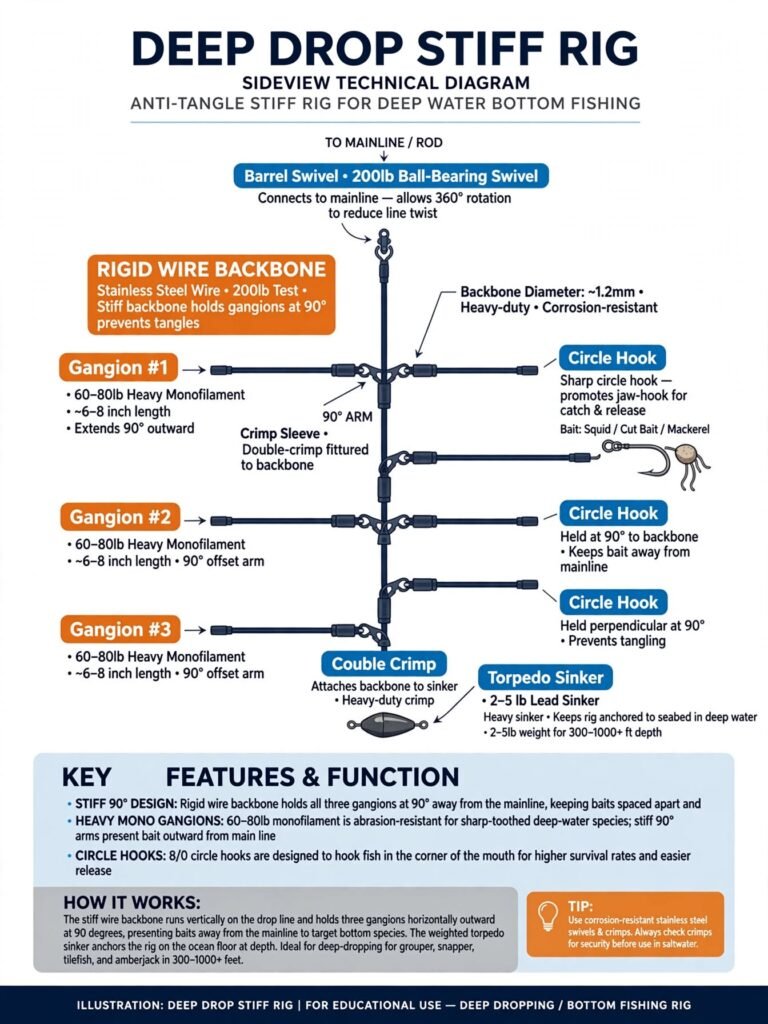
Stiff rig deep drop diagram showing rigid wire backbone holding gangions at 90 degrees to prevent tangles in strong current
deep_drop_stiff_rig_technical_diagram

Caption: Stiff rig — the wire backbone keeps hooks locked at 90 degrees. My go-to past 800 ft when current is ripping.

Downside: It takes longer to build and you can’t coil it. You need a dedicated rig tube or PVC holder. Don’t try to stuff it in a tackle bag.

The Dropper Rig: Fast and Simple

The dropper rig is the minimalist. No separate gangions. You tie loops directly into your mainline.

The Build:

  • Mainline: 4-6 ft of 100-150lb mono.
  • Loops: 2-3 dropper loops or surgeon’s loops, each 4-5 inches long, tied directly into the mainline. Spaced 12-14 inches apart.
  • Hooks: Loop-to-loop connection with your circle hook. Use a quick clip if you want to change hooks fast.
  • Weight: 12oz – 24oz for shallower deep-drops (400-600 ft). You don’t need 4lbs here.

Best for: Faster rigging when you’re prospecting new bottom, fishing shallower deep-drop depths (400-600 ft), or when you want to lose cheap rigs on rocks without crying. I use it for rosy jobfish and grouper in the Andaman when exploring new numbers.

Why anglers use it: It’s the fastest to tie boat-side when the bite is hot. If a hook dulls on a rock, you just clip on a new one. It holds fewer hooks (2-3), so you catch fewer fish per drop, but you get more drops in.
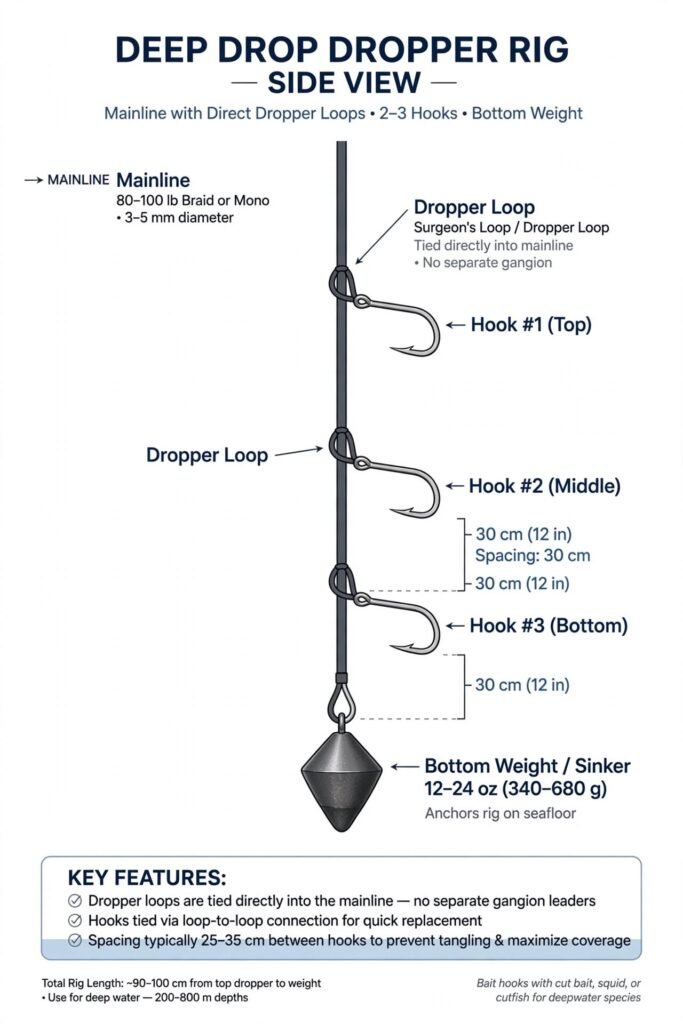
Simple deep drop dropper rig with dropper loops tied directly into mainline with 3 hooks and bottom weight

Which Rig Should You Use?

Don’t overthink it. Here’s my cheat sheet from the rail:

Rig TypeCurrent ToleranceTangle ResistanceSetup DifficultyBest DepthBest Target
Chicken RigModerate (0.5-1.5kt)GoodEasy500-1,000 ftGolden Tilefish, Blanquillo, General Bottom
Stiff RigHigh (1.5-3+kt)ExcellentModerate800-1,300+ ftSnowy Grouper, Yellowedge, Warsaw
Dropper RigLow-ModerateFairEasiest400-700 ftProspecting, Snapper, Smaller Grouper

If you’re just starting: Begin with a chicken rig for deep drop fishing. Pre-tie 5 rigs on a rig board with 6/0 hooks for tilefish. Once you’re consistently hitting 800+ ft or fishing in 2 knots of current, build 3 stiff rigs.


How to Build a Basic Deep Drop Rig

This is my 5-minute boat-side chicken rig build:

  1. Cut Mainline: Cut 7 ft of 200lb mono. Crimp a 200lb ball-bearing swivel on top.
  2. Add Gangions: Starting 18 inches below top swivel, crimp in a 3-way swivel. Attach a 10-inch 60lb fluoro gangion with a 6/0 circle hook, glow bead, and glow sleeve. Repeat 3 more times, 18 inches apart.
  3. Finish Bottom: 18 inches below last gangion, crimp a heavy-duty snap swivel for your sinker.
  4. Check Spacing: Lay it flat. No gangion should be able to reach another hook. If they touch, you will tangle.
  5. Store Right: Wind it around a foam rig board or pool noodle. Never coil it in your hand. Add a piece of tape over each hook.

Weight Selection: Start with 2lb. If you can’t feel bottom or your line is at 45 degrees, go up 1lb at a time. In Port Blair’s deep channels, I often need 4lb with a 2-knot tide.

Gear You’ll Need & Common Mistakes {gear}

Essential Kit: Electric reel (Banax 1000 / Tanacom 1000), 80lb braid mainline, 2-5lb torpedo sinkers, crimping pliers, 200lb mono, 60-80lb fluoro, 3-way swivels, double-barrel crimps, circle hooks 6/0-12/0, glow beads, foam rig boards.

Mistakes I see every week:

  1. Using J-hooks. Circle hooks are mandatory for deep drop — they corner-hook the fish and you don’t need to set the hook at 1,000 ft.
  2. Gangions too long. Keep them under 12 inches or they’ll wrap.
  3. Cheap swivels. A $0.50 swivel will twist and fail at 900 ft. Use ball-bearing.
  4. Storing rigs in a bag. Use a rig board. Always.

FAQ

What’s the difference between a chicken rig and a stiff rig?
A chicken rig relies on line tension and 18″ spacing to prevent tangling, while a stiff rig uses a rigid wire or 300lb mono backbone to physically lock gangions at 90 degrees — making it virtually tangle-proof in strong current past 800 feet.

How many hooks should a deep drop rig have?
Most deep drop rigs run 3-5 hooks. 5 is standard for tilefish, 3 is standard for big grouper to avoid gut-hooking multiple large fish. Check local regulations — some US zones limit you to 3 hooks.

Can I reuse a deep drop rig?
Yes, if it’s not kinked. I reuse chicken rigs 2-3 times if the mono isn’t chafed. Stiff rigs last longer if you rinse them. Always replace any gangion that caught a fish — check for abrasion above the hook.

What is the best bait for deep drop rigs?
Fresh-cut Bonito belly, squid strips, and Boston Mackerel. Tip with a 2″ glow squid skirt at 800+ ft. Tilefish love small chunks, grouper want a big, oily chunk.

How heavy should my sinker be?
Base rule: 1lb per 200ft + 1lb per knot of current. So 800 ft in 2 knots = 6lb. Start heavy, you can always go lighter.


Fishing regulations, including hook limits and gear restrictions, vary by location and season. Always check current official rules for your area before heading out.

Scroll to Top